

Solar Noon: What It Is and Why It Rarely Matches Clock Noon
The exact moment the sun reaches its highest point in the sky — and why that moment almost never lines up with 12:00 on your clock.
Table of Contents
1. What Is Solar Noon?
Definition and how it differs from clock noon
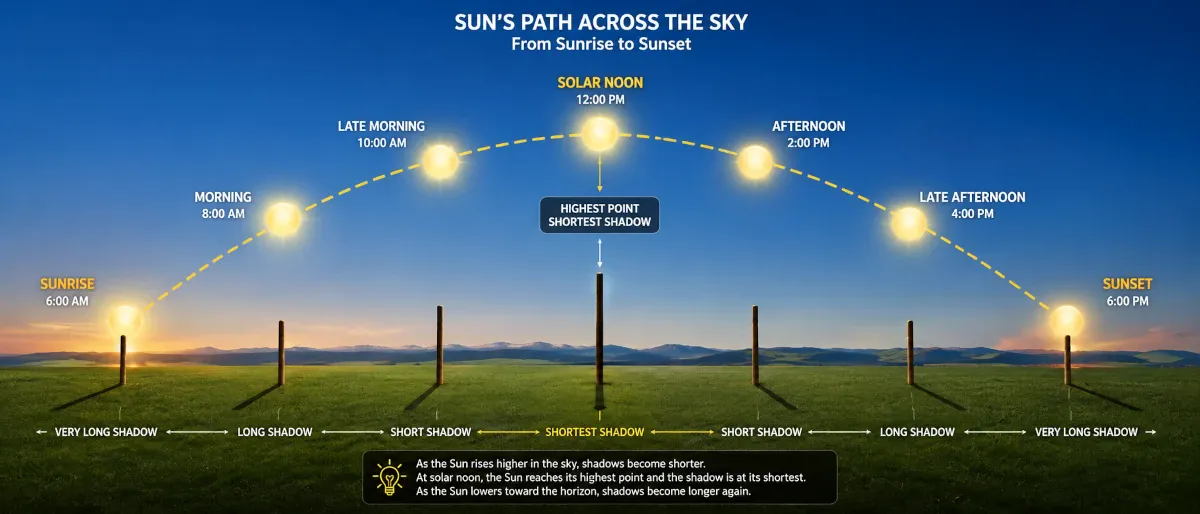
Solar noon is the moment each day when the sun reaches its highest point in the sky at a given location — the instant it crosses the local meridian, the imaginary north-south line passing directly overhead. This moment is more precisely called meridian transit or upper transit. At that instant, any shadow cast by a vertical object is as short as it will get that day. Where the sun appears in the sky at that moment depends on latitude and the sun's declination: it's due south of an observer whose latitude is north of the sun's declination, due north when the reverse is true, and directly overhead when the two match exactly — a distinction that matters most within the tropics, where all three can occur at the same location over the course of a year.
Civil noon, by contrast, is simply 12:00 according to the local civil time system. Clock time is a human convenience built around time zones, each spanning roughly 15 degrees of longitude and keyed to a single standard meridian. Solar noon is tied to the sun's actual position and varies with longitude and date; the clock time at which it occurs also depends on the local time zone and daylight saving rules — which is why the two rarely coincide.
Solar noon vs. "high noon" (common misconception)
"High noon" is an informal expression for midday and isn't a precise astronomical definition. In everyday usage it usually just means "around 12:00," without accounting for time zones or the equation of time. Solar noon is the precise, location-specific version of that idea — the actual moment of the sun's daily meridian transit, not an approximation.
2. Why Solar Noon Rarely Falls at 12:00 PM
Several factors combine to push solar noon away from 12:00 on the clock, often by 30 minutes or more. In some U.S. locations, solar noon can occur more than an hour after 12:00 PM during daylight saving time — for example, on the far eastern edge of a time zone in midsummer.
Time zones and standard meridians
Each time zone is anchored to a single standard meridian, but the zone itself spans about 15 degrees of longitude on either side. Only locations sitting exactly on the standard meridian see clock noon align closely with solar noon (before adjusting for the equation of time). Everywhere else within the zone, solar noon happens earlier or later depending on how far east or west of that meridian the location sits.
The equation of time
Earth's orbit is elliptical, not circular, and its axis is tilted relative to its orbital plane. Both factors cause the sun's apparent motion across the sky to speed up and slow down slightly over the course of a year, a discrepancy astronomers call the equation of time. It shifts solar noon by as much as about 16 minutes early or 14 minutes late relative to "mean" solar time, following a repeating pattern with two peaks and two troughs annually.
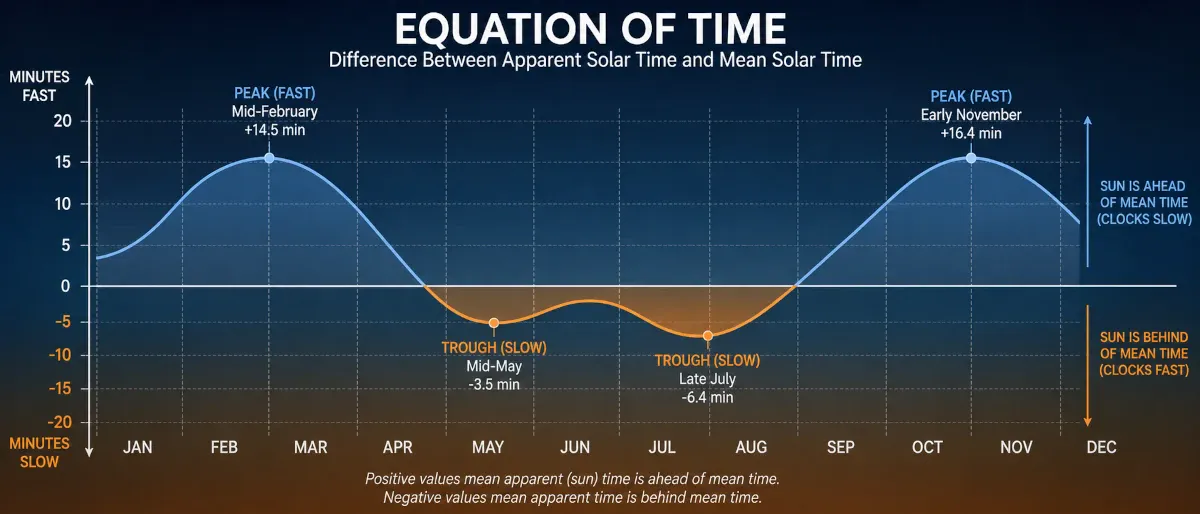
This is easier to follow with one extra concept: apparent solar time, the time actually indicated by the sun's real position, as a sundial would show it. The equation of time is simply the gap between apparent solar time and mean solar time (an idealized, evenly-ticking version of solar time). Civil clock time then adds a fixed zone offset — and daylight saving time when active — on top of mean solar time. So the chain runs: apparent solar time → equation of time correction → mean solar time → civil clock time.
Daylight saving time offset
Where daylight saving time is observed, clocks are moved forward by an hour for part of the year, adding a full 60-minute offset on top of everything else. During DST, solar noon typically falls closer to 1:00 PM local clock time rather than 12:00, even before accounting for longitude and the equation of time.
Longitude within a time zone
Every degree of longitude corresponds to roughly 4 minutes of time difference in the sun's position. A location near the western edge of its time zone will see solar noon later in the clock day than a location near the eastern edge, simply because the sun reaches each meridian at a different actual moment while both places share the same zone time.
3. How Solar Noon Is Calculated
At its core, solar noon calculation identifies the instant the sun reaches its maximum altitude for the day — its meridian transit — for a specific date and location. The general approach:
- Start from local mean solar time, based purely on longitude relative to the time zone's standard meridian.
- Apply the equation of time correction for that calendar date, which accounts for orbital eccentricity and axial tilt.
- Adjust for the time zone offset actually in use, including daylight saving time if applicable.
Expressed as a simplified formula (commonly used in solar-position references such as NOAA's solar calculator), solar noon in minutes from UTC midnight works out to:
with longitude in degrees east of Greenwich (west is negative) and the equation of time in minutes for that date. The result is then converted to local clock time by applying the time zone offset and any daylight saving adjustment.
The math behind the equation of time itself involves orbital mechanics and isn't something worth doing by hand for everyday purposes. In practice, solar position algorithms handle the calculation instantly for any date and coordinate pair — the calculator further down this page does exactly that using your device's location or a searched city.
4. Solar Noon Throughout the Year
How it shifts day to day
Because the equation of time changes continuously, solar noon drifts slightly from one day to the next. The change is typically on the order of a few seconds to a few tens of seconds per day, depending on the time of year.
Earliest and latest solar noon dates
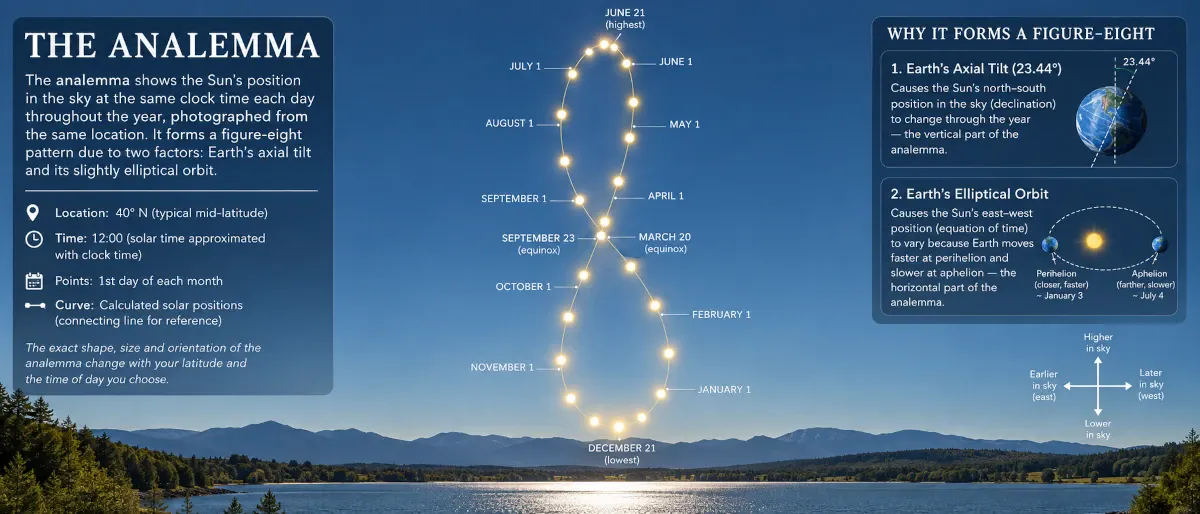
In mean solar time, the equation of time makes solar noon earliest around early November and latest around early-to-mid February, corresponding to the extremes of the equation of time curve. The actual clock time of solar noon at a particular location also depends on that location's longitude, its time zone's rules, and whether daylight saving time is active — so this "earliest/latest" pattern shifts the underlying mean solar time, not necessarily the exact clock time everyone sees. The pattern is closely tied to the analemma — the figure-eight shape traced by plotting the sun's position at the same clock time every day for a year, which visualizes the combined effect of the equation of time and axial tilt.
Solstice and equinox variations
Solar noon's clock time doesn't shift dramatically around solstices and equinoxes specifically — that pattern belongs to the equation of time curve described above, not to the solstice/equinox dates themselves. What does change sharply at solstices and equinoxes is the sun's altitude at solar noon (covered in the next section) and day length, not the timing of solar noon itself.
5. Solar Noon by Latitude
While the timing of solar noon depends mainly on longitude, date, and time zone, the sun's altitude at solar noon depends heavily on latitude and season.
- At the equator: the sun passes very close to directly overhead at solar noon around the equinoxes, and within about 23.5 degrees of overhead year-round.
- Within the tropics (between roughly 23.5°N and 23.5°S): the sun can appear directly overhead at solar noon. Locations strictly between the two tropic lines experience this twice a year; locations sitting exactly on the Tropic of Cancer or Tropic of Capricorn experience it once, near the corresponding solstice.
- In mid-latitudes: the sun never reaches directly overhead; its solar-noon altitude varies substantially between summer and winter but always leaves a measurable shadow.
- Near the poles: solar noon altitude is extremely low in winter (or the sun doesn't rise at all) and comparatively high during the local summer, when the sun may remain above the horizon for 24 hours.
- At the geographic poles themselves: the standard definition of solar noon breaks down, since every line of longitude — every meridian — converges at the pole, so there's no single local meridian left to cross. Instead of a distinct daily meridian transit, the sun's altitude there changes gradually across the day, reaching its yearly maximum around the local summer solstice and its minimum (below the horizon, in polar night) around the winter solstice.
This is why "solar noon" and "sun directly overhead" are often confused but aren't the same thing — for most inhabited latitudes, the sun is never truly overhead at solar noon, only at its highest angle for that day.
6. Practical Uses of Solar Noon
Sundials and traditional timekeeping
A properly aligned sundial indicates apparent solar time, with local solar noon occurring as the sun crosses the sundial's meridian. Historically, solar noon was the primary reference point for setting local time before time zones standardized clocks across wide regions.
Photography
Solar noon often produces relatively high-angle, contrasty light with shorter shadows, since the sun sits closer to overhead than at any other point in the day. Golden hour, by contrast, produces lower-angle, softer light around sunrise and sunset — a look many photographers prefer for portraits and landscapes, though this is a matter of style rather than a fixed rule.
Solar panel positioning and solar energy
Fixed solar panels are often oriented to maximize exposure around solar noon, when the sun is highest and sunlight travels through the least atmosphere. Solar noon is often near the period of strongest potential solar irradiance on a clear day, but actual panel output can peak before or after solar noon depending on panel orientation, cloud cover, temperature, and other system characteristics. Tracking systems that follow the sun rely on solar noon calculations as a reference point for their daily arc.
Agriculture and outdoor work planning
Solar noon is usually close to the time of highest solar elevation and, under clear skies, often near the period of strongest UV radiation — informing decisions about scheduling fieldwork, irrigation timing, and livestock shade needs. Cloud cover and atmospheric conditions can shift the actual UV peak somewhat.
Navigation and historical timekeeping
Before satellite navigation, sailors used the sun's position at solar noon (a technique called "noon sighting") to determine latitude. The observer didn't need to know the exact clock time of solar noon in advance — a mariner could simply track the sun as it climbed toward its highest point, note that maximum altitude, and combine it with the sun's known declination for that date to calculate latitude.
7. Solar Noon vs. Related Concepts
Solar noon vs. sunrise/sunset midpoint
Solar noon is often a useful approximation of the midpoint between sunrise and sunset, but it isn't necessarily exactly halfway between them. The sun's declination changes gradually over the course of a day, introducing a small asymmetry between the morning and afternoon halves. The difference is usually negligible at ordinary latitudes but can become more noticeable at high latitudes.
Solar noon vs. local mean time vs. UTC
Local mean time is an idealized clock time based purely on longitude, without the equation of time correction. UTC is a single global reference time unrelated to any specific location's sun position. Solar noon differs from both — it's the true, observed position of the sun, while local mean time and UTC are administrative or averaged constructs.
Brief mention of solar midnight
Solar midnight is the approximate counterpart to solar noon: the time when the sun is at its lowest position relative to the local meridian, roughly 12 solar hours after solar noon at the same location. As with solar noon, the usual daily noon/midnight picture becomes less straightforward at high latitudes and breaks down entirely at the geographic poles.
8. Find Solar Noon for Your Location
Solar noon for today's date, based on your location or a city you search below.
9. Frequently Asked Questions
Almost never exactly. Solar noon shifts away from 12:00 clock time based on how far a location sits from its time zone's standard meridian, the equation of time for that date, and whether daylight saving time is in effect.
Yes. When clocks move forward an hour for daylight saving time, solar noon's clock-time value moves an hour later too, often landing closer to 1:00 PM than 12:00 PM.
Zenith is the point directly overhead in the sky. Solar noon is the moment the sun reaches its highest point for the day, which only equals true zenith (directly overhead) at certain latitudes on certain dates — mainly within the tropics.
Outside the tropics, the sun's maximum daily altitude never reaches 90 degrees (straight up), because latitude and axial tilt limit how high it can climb. The sun still reaches its highest point of the day at solar noon — it's just not directly overhead.
Yes. Combine a location near the western edge of its time zone, an equation-of-time offset, and daylight saving time, and solar noon can land well after 1:00 PM on the clock.
No. Solar noon varies continuously with longitude, even though every clock within a time zone shows the same civil time. Two cities in the same zone can have solar noon several minutes apart.
At almost every location, yes — once per day, without fail. The exception is the geographic poles, where the conventional definition breaks down because all meridians converge there.