
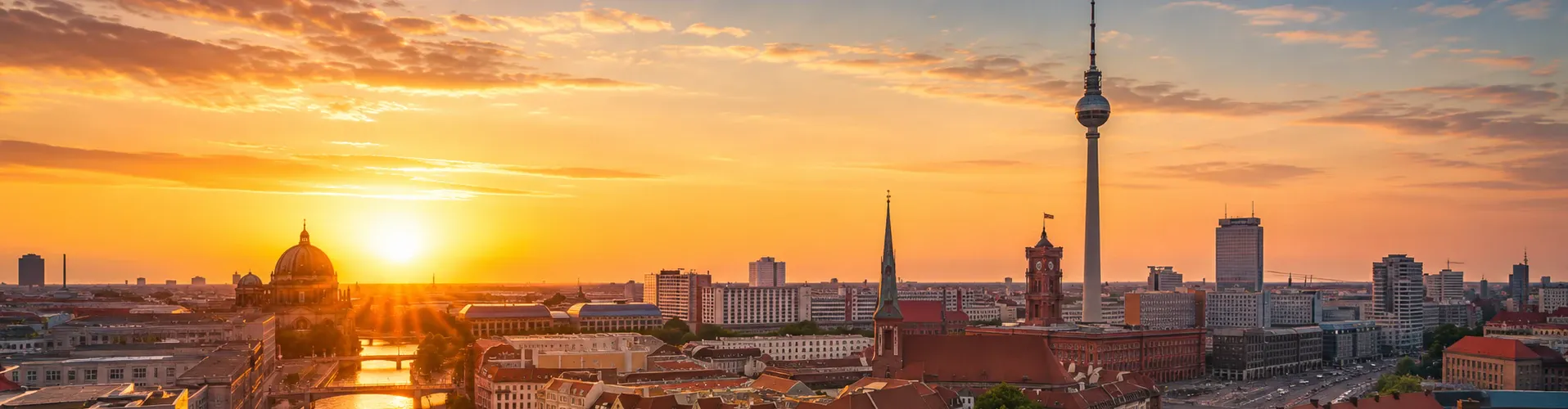
☀ Best Places to Watch Sunrise & Sunset in Berlin
Berlin is famously flat — the surrounding North German Plain leaves the city with almost no natural hills — so most of its best viewpoints are either artificial rises or wide-open horizons rather than skyline lookouts. Several of the highest points in the city, including Teufelsberg and the smaller Trümmerberge ("rubble mountains") scattered across town, were built largely from rubble cleared from Berlin after the Second World War. The Spree winds roughly east–west through the historic center, and many of its bridges offer attractive sunset compositions depending on which way you're facing, while Berlin's waterways — including the Havel to the west, Wannsee to the southwest, and Müggelsee to the east — offer some of the closest things the city has to an open-water horizon. As with most of Central Europe, the lower, more southerly winter sun produces longer shadows and can create dramatic low-angle light, while the summer sun follows a much higher, longer arc across the sky.
Teufelsberg & Drachenberg – Grunewald Sunset
At 120.1 meters above sea level, Teufelsberg is one of Berlin's highest elevations — an artificial hill piled from wartime rubble beneath a former Allied listening station whose abandoned radomes are now covered in street art. From the summit and the neighboring Drachenberg, the view opens west over the Grunewald forest and the Havel. Nearest transit: S-Bahn Grunewald (S7), roughly a 25-minute walk through the forest depending on the route, or bus M49/X34 to the Teufelssee stop from S-Bahnhof Heerstraße. Entry to the former listening station currently costs €10; the surrounding forest paths and hilltop are free to access.
Tempelhofer Feld – Tempelhof SunriseSunset
Berlin's former Tempelhof Airport, whose monumental terminal complex dates to the Nazi era, is now the city's largest open space — nearly 300 hectares of former runways and grassland with an uninterrupted horizon in almost every direction, making it one of the few spots in Berlin equally good for sunrise or sunset. Popular with cyclists, kite-fliers, and picnickers. Nearest transit includes Tempelhof (U6/S-Bahn) and Paradestraße (U6) on the western side, and Boddinstraße or Leinestraße (U8) for the eastern entrances, with a short walk required from any station to the field itself.
Oberbaumbrücke Sunset
A red-brick, twin-towered bridge in Gothic Revival style spanning the Spree between Kreuzberg and Friedrichshain, doubling as a former Cold War border crossing and today's elevated U1/U3 crossing. Sunset views can combine the bridge, the Spree, and parts of Berlin's historic skyline, including the TV Tower from suitable positions, making it a popular photography location. Nearest transit: U-Bahn Schlesisches Tor (U1) or Warschauer Straße (U1/U3/S-Bahn).
Viktoriapark – Kreuzberg Sunset
The highest natural hill inside the city center, topped by the Kreuzberg's national monument and fed by an artificial waterfall on its western slope. The elevated western-facing lawns give a clear, tree-framed view over Kreuzberg and Schöneberg as the sun goes down. Nearest transit: U-Bahn Platz der Luftbrücke or Mehringdamm (U6/U7), then a short walk uphill.
Müggelsee – Treptow-Köpenick SunriseSunset
Berlin's largest lake, in the wooded far east of the city, offers the nearest thing to a true water horizon anywhere in town, with lakeside beer gardens and beaches along the shore at Friedrichshagen. Quiet enough for both dawn and dusk light. Nearest transit: S-Bahn Friedrichshagen (S3), then a short walk or tram down to the lakeshore.
Wolkenhain – Kienbergpark, Marzahn SunriseSunset
A filigree, cloud-shaped viewing platform atop Kienberg, a roughly 110-meter artificial hill in eastern Berlin, with the lookout itself reaching about 120 meters above sea level. It's reached by cable car or on foot through the adjoining Gardens of the World, and is one of the city's more unusual 360-degree viewpoints. The Kienbergplateau is open from sunrise to sunset in summer; in autumn and winter it generally runs about 7:30am–7:30pm, subject to weather-related closures — the cable car itself keeps separate, more limited hours. Nearest transit: U-Bahn Kienberg – Gärten der Welt (U5).
◉ Best Times for Sun Photography
📷 Quick Photography Tips
Berlin operates on CET (UTC+1) in winter and CEST (UTC+2) during daylight saving time, which in the EU runs from the last Sunday in March to the last Sunday in October — worth double-checking against whichever sunrise/sunset app or table you're using so the offset matches.
For sunrise and sunset times in any other city worldwide, visit our sunrise/sunset calculator on the home page.
✓ Your Berlin Sunrise & Sunset Checklist
Before You Go
- Check today's exact sunrise/sunset times above, and confirm whether you're in CET or CEST for the date you're planning
- For Teufelsberg, check whether the listening station itself is open if you want to climb inside the radomes — the surrounding forest paths and hilltop can be accessed independently of the listening-station admission, subject to normal park conditions
- For Wolkenhain, check Kienbergpark's seasonal hours before heading out for a very early or very late visit, since winter hours are shorter
- Target November through February for the lowest, most southerly arc and often good visibility on clear, dry days
What to Bring
- Sturdy tripod — hilltop and exposed lakeside positions on this list can be windy, especially in unsettled weather
- A longer lens for TV Tower and skyline-compression shots; a wide-angle for Tempelhofer Feld or lakeside compositions
- Cold-weather layers October through March — exposed hills like Teufelsberg and Viktoriapark run colder than sheltered streets
- A BVG ticket or app ready — most of these spots are best reached by U-Bahn or S-Bahn, and parking is limited at Teufelsberg and Müggelsee
On the Morning or Night
- Arrive 30–45 minutes before sunrise or sunset, especially on clear summer weekends
- Shoot RAW and bracket exposures to hold detail in both the sun and the skyline or water
- At the Oberbaumbrücke, check your composition from the riverbank first — a wide frame from the Friedrichshain side can hold the bridge, the TV Tower, and the sunset together
- At Müggelsee or the Havel–Wannsee lakes, remember the sun's setting point shifts north or south along the tree line with the season — it won't be in the same spot in July as in January