Sunrise, sunset, golden hour and daylight hours for New York, New York
☀ Best Places to Watch Sunrise & Sunset in New York City
The same geometry that makes Manhattan's skyline so photogenic at moonrise applies to the sun, with one added twist: Manhattan's street grid, laid out under the Commissioners' Plan of 1811, runs a few degrees off true east–west — which is why, twice a year, the setting sun lines up directly with the cross streets in the phenomenon known as Manhattanhenge. Beyond that specific alignment, the basic rule holds for sunrise and sunset alike: locations on the New Jersey side of the Hudson face east toward the skyline and catch the sun rising behind the towers, while locations in Brooklyn and Queens face west across the rivers and catch the sun setting behind Manhattan. Winter months bring a lower, more southerly arc for both sunrise and sunset, which tends to align the sun with the skyline for longer and gives sharper results than the haze of a humid summer evening.
Port Imperial & Hamilton Park – Weehawken, NJ Sunrise
The Hudson River Waterfront Walkway through Port Imperial and neighboring Hamilton Park sits directly across the Hudson from Midtown, facing east toward the skyline. Hamilton Park is also the site where Alexander Hamilton was fatally wounded in his 1804 duel with Aaron Burr. NY Waterway runs ferries from the Port Imperial terminal to Midtown/W. 39th St., Pier 11/Wall St., and Brookfield Place, with the terminal open from 6 a.m. most weekdays; the Hudson–Bergen Light Rail also stops at Port Imperial.
Liberty State Park – Jersey City, NJ Sunrise
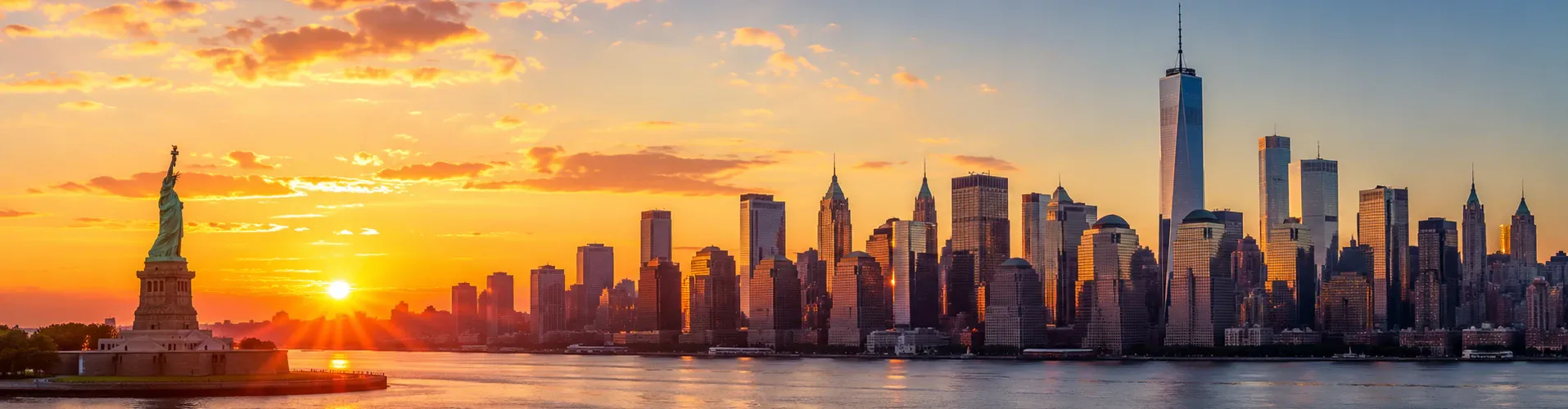
Liberty State Park looks east across the harbor toward the Statue of Liberty, Ellis Island, and the Lower Manhattan skyline, with a wide, largely unobstructed eastern horizon. Reachable by car, by Hudson-Bergen Light Rail, or via Liberty Landing Ferry from the Battery Park City Ferry Terminal at Brookfield Place in Manhattan. Free; open daily, sunrise to sunset.
Brooklyn Heights Promenade Sunset
A roughly 1,800-foot esplanade built over the BQE, facing west across the East River toward Lower Manhattan, the Brooklyn Bridge, and New York Harbor — one of the most photographed skyline views in the city. Open 24 hours. Nearest transit: Clark St (2/3) or Court St / Borough Hall (2/3/4/5/R). A footbridge (Squibb Park Bridge) connects it down to Pier 1 in Brooklyn Bridge Park.
Hunter's Point South Park & Gantry Plaza – Long Island City Sunset
NYC Parks names this Queens waterfront, along with Manhattan cross streets like 42nd and 14th, as an official Manhattanhenge viewing spot — face west across the East River for the full Midtown skyline in one frame, including the Empire State and Chrysler Buildings. Nearest transit: Vernon Blvd–Jackson Ave (7 train).
Louis Valentino Jr. Park & Pier – Red Hook, Brooklyn Sunset
A small NYC Parks waterfront property with, per NYC Parks, direct views of the Statue of Liberty, Governors Island, the Manhattan skyline, and Staten Island — regarded as the closest front-facing view of the statue from anywhere on land in the city. Less crowded than the Brooklyn or Manhattan waterfronts. Limited public transit; nearest options are the B61 bus or a walk from the Smith–9th Sts (F/G) subway station.
Riegelmann Boardwalk – Coney Island, Brooklyn SunriseSunset
New York City's only true open-ocean horizon: the 2.5-mile boardwalk, built in 1923, faces the Atlantic to the south. In winter, when the sun's arc runs lower and further south, sunrise and sunset both occur out over open water; in summer the sun rises and sets further north, closer to the boardwalk's landward end. Nearest transit: Coney Island–Stillwell Ave (D/F/N/Q).
◉ Best Times for Sun Photography
📷 Quick Photography Tips
New York operates on EST (UTC−5) in winter and EDT (UTC−4) during daylight saving time, which runs from the second Sunday in March to the first Sunday in November — worth double-checking against whichever sunrise/sunset app or table you're using so the offset matches.
For sunrise and sunset times in any other city worldwide, visit our sunrise/sunset calculator on the home page.
✓ Your New York Sunrise & Sunset Checklist
Before You Go
- Check today's exact sunrise/sunset times above, and confirm whether you're in EST or EDT for the date you're planning
- For Manhattanhenge, target the full-sun dates (May 29 or July 11, 2026) if you can only make one — the entire disc sits framed between the buildings on those evenings
- For Liberty State Park or the Weehawken/Port Imperial waterfront, check NY Waterway or Liberty Landing Ferry schedules in advance if you're relying on the ferry rather than driving or light rail
- Target October through February for the lowest, most southerly arc and generally clearer air
What to Bring
- Sturdy tripod — Hudson and East River winds are persistent at every waterfront on this list
- A longer lens for skyline-compression shots from New Jersey; a wide-angle for Brooklyn Bridge-adjacent or boardwalk compositions
- Cold-weather layers October through March — waterfront positions channel wind and run colder than inland streets
- A MetroCard/OMNY card or transit app ready — most of these spots are best reached by subway, light rail, or ferry, and parking is limited at several (especially Weehawken and Red Hook)
On the Morning or Night
- Arrive 30–45 minutes before sunrise or sunset — the best waterfront positions fill up on Manhattanhenge dates and clear-sky weekends
- Shoot RAW and bracket exposures to hold detail in both the sun and the skyline or water
- At Valentino Pier or Liberty State Park, the Statue of Liberty sits close enough to the skyline that a single wide frame can hold both — check your composition before the light peaks
- At the Coney Island boardwalk, remember the sun's landing point shifts north or south along the horizon with the season — it won't be in the same spot in July as in January