Sunrise, sunset, golden hour and daylight hours for Sydney, Australia
☀ Best Places to Watch Sunrise & Sunset in Sydney
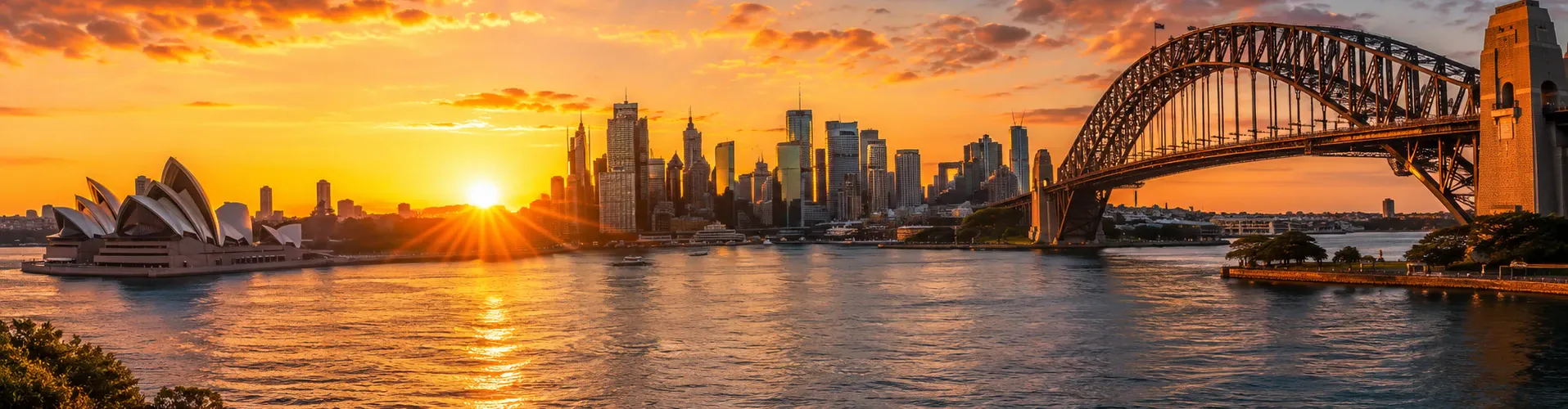
Sydney's geography splits neatly along an east–west line: the ocean beaches of the Eastern Suburbs — Bondi, Bronte, Coogee — face directly out onto the open Pacific and catch the sun coming up over the water, while the harbour side of the city, from The Domain around to Millers Point and Barangaroo, faces back toward the CBD skyline and the Harbour Bridge, making it the natural home for sunset. Unlike New York's Manhattanhenge, no comparable street-grid sun alignment has really taken hold here — Sydney's drama comes from its harbour geometry rather than a grid. Because Sydney sits well south of the equator, its seasons run in reverse of the Northern Hemisphere: the December solstice brings the longest days and a high, southerly sun arc, while the June solstice brings the shortest days and a lower, more northerly arc.
Notts Avenue / Bondi Icebergs Sunrise
At the southern end of Bondi Beach, the lookout on Notts Avenue faces east onto open water and sits right beside the ocean-fed pool at the Bondi Icebergs Club, so you can watch both the sunrise and the early swimmers. For a quieter, more elevated alternative at the beach's northern end, walk up to Ben Buckler Point. Nearest transit: Sydney Trains T4 line to Bondi Junction, then Bus 333 or 380/381 to Bondi Beach.
Bronte Beach Sunrise
Smaller and quieter than Bondi, Bronte Beach faces east toward the Pacific and sits on the Bondi to Coogee coastal walk, with the ocean-fed Bronte Baths as a foreground for the first light. Nearest transit: Sydney Trains T4 line to Bondi Junction, then Bus 379 to the Bronte Beach terminus.
Mrs Macquarie's Chair – The Domain SunriseSunset
A sandstone bench hand-carved by convicts in 1810 for Elizabeth Macquarie, wife of Governor Lachlan Macquarie, on a harbourside point looking toward Fort Denison, with the Sydney Opera House and Harbour Bridge visible across the water — suited to both early morning light and evening golden hour. Nearest transit: walk through the Royal Botanic Garden from Circular Quay station, or take Bus 441.
Observatory Hill – Millers Point Sunset
One of the highest points in the Sydney CBD, this hilltop park looks directly across to the Sydney Harbour Bridge and North Sydney; even though the sun itself sets in the opposite direction, the colour tends to sweep around the hill. It's also home to the historic Sydney Observatory. Nearest transit: a walk from Wynyard or Circular Quay stations, or from Barangaroo Station.
Barangaroo Reserve Sunset
A west-facing harbourside park at the northern edge of the CBD, built on reclaimed industrial land, with open, level sightlines across the water for sunset. Nearest transit: Barangaroo Station on the Sydney Metro M1 Line, which opened in August 2024 near Barangaroo Reserve.
North Head – Manly Sunrise
NSW National Parks itself recommends North Head as one of Sydney's best sunrise spots: the wheelchair-accessible Fairfax Walk has several lookouts over the sea cliffs where the sun comes up over the ocean, and whales are sometimes visible from May to November. The headland also has harbour-facing lookouts, including the Burragula Lookout, with views back across the harbour entrance to the city skyline. Reachable via the Manly Ferry from Circular Quay, then a walk or the 135 bus into North Head. Gates are open 6am–8:30pm during daylight saving and 6am–6pm the rest of the year — check current NSW National Parks opening hours and alerts before visiting, since access can change.
◉ Best Times for Sun Photography
📷 Quick Photography Tips
Sydney operates on AEST (UTC+10) for most of the year and AEDT (UTC+11) during daylight saving time, which runs from the first Sunday in October to the first Sunday in April — the reverse of the Northern Hemisphere's DST calendar, so it's worth double-checking against whichever sunrise/sunset table you're using.
For sunrise and sunset times in any other city worldwide, visit our sunrise/sunset calculator on the home page.
✓ Your Sydney Sunrise & Sunset Checklist
Before You Go
- Check today's exact sunrise/sunset times above, and confirm whether you're on AEST or AEDT for the date you're planning — Sydney's daylight saving runs October to April, opposite the Northern Hemisphere
- For Bondi, Bronte, or the Bondi to Coogee walk, check tide conditions before photographing the rock platforms and pools, and stay clear of exposed surf zones
- For Manly or North Head, check Manly Ferry timetables and current NSW National Parks opening hours and alerts before you go
- Target the period around the December solstice for the highest, most southerly sun arc and the longest days; the period around the June solstice for the lowest, most northerly arc and the shortest days
What to Bring
- Sturdy tripod — harbour headlands and clifftop spots on this list can be windy
- A longer lens for skyline-compression shots of the Harbour Bridge and Opera House; a wide-angle for the Bondi to Coogee cliffs or Bronte Beach
- A light layer even in summer — early mornings on exposed headlands like North Head or Ben Buckler Point run cooler than inland Sydney
- An Opal card or contactless payment method ready — most of these spots are best reached by train, bus, or ferry, and parking is limited at several, especially Bondi and Bronte on weekends
On the Morning or Night
- Arrive 30–45 minutes before sunrise or sunset to give yourself time to find a position and set up
- Shoot RAW and bracket exposures to hold detail in both the sun and the water or skyline
- At Mrs Macquarie's Chair, the Opera House and Harbour Bridge sit close enough together that a single wide frame can hold both — check your composition before the light peaks
- Along the Bondi to Coogee walk, remember the sun's landing point shifts north or south along the horizon with the season — it won't rise in the same spot in July as in January