The Sun right now
Live data from NOAA and NASA, updated every few minutes.
Loading...
Fetching the latest readings from NOAA.
The Sun now
Flare level
--
X-ray class right now
6-hour peak
--
Strongest flare level
Solar wind
--
km/s
Density
--
particles/cm³
--
Working out when the latest solar wind reaches Earth.
Solar flares, last 6 hours
X-ray brightness from the Sun, measured by a NOAA GOES satellite. Each letter class is ten times stronger than the one before it. A and B are quiet, C is common, M is strong and X is major.
Solar wind speed, last 2 hours
Solar wind usually flows at about 300 to 500 km/s. Speeds above 600 km/s are fast, and they often come from coronal holes or eruptions on the Sun.
What does it mean?
Solar flares
A sudden flash of energy from the Sun, seen as a bright spot in the 304 Å image and as a spike in the X-ray chart. Flares can briefly disturb radio signals on the sunlit side of Earth.
Coronal mass ejections
A coronal mass ejection (CME) is a huge cloud of plasma thrown out by the Sun. If one is aimed at Earth, it can take roughly 1 to 3 days to arrive.
Coronal holes
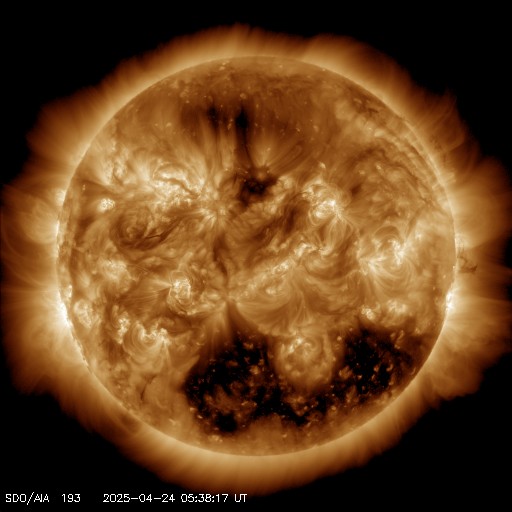
Dark patches in the 193 Å image where the Sun's magnetic field opens into space. They release fast solar wind, which can reach Earth a few days after the hole faces us.
Sunspots
Cooler, darker areas with strong magnetic fields. Large, tangled groups are where most flares and CMEs begin.
Never look straight at the Sun without a certified solar filter, and never through binoculars or a telescope without one. Eye damage can be permanent and painless. The images on this page come from satellites, so they are safe to view.
Data: NOAA Space Weather Prediction Center (swpc.noaa.gov). Sun images courtesy of NASA/SDO and the AIA, EVE, and HMI science teams (sdo.gsfc.nasa.gov). This page is for information and hobby use and is not an official forecast.
A plain-English guide to space weather
Every aurora starts 150 million kilometres away, on the Sun. This guide walks through what travels from there to here, why Earth sometimes lights up, and how to get the most out of the live readings on this page.
From Sun to sky: four steps
The same chain of events sits behind every northern and southern lights display.
- 1
The Sun throws off material
A constant flow of charged particles, the solar wind, streams away from the Sun. Coronal holes make it faster, and flares and coronal mass ejections (CMEs) can add bursts of extra material.
- 2
It crosses space
Everyday wind takes a few days to arrive. A fast CME can get here in one to three days. Satellites parked about 1.5 million km sunward of Earth measure the wind roughly 30 to 60 minutes before it reaches us.
- 3
Earth's magnetic field lets it in
When the magnetic field carried by the wind points south (a negative Bz), it connects with Earth's field, and energy flows into near-Earth space far more easily.
- 4
The atmosphere glows
Energised particles are steered toward the polar regions and collide with gases high above the ground. Oxygen gives the familiar green, and red higher up. Nitrogen can add blue or purple edges.
What each reading on the page tells you
None of these is a crystal ball on its own. Together they tell a story.
Verdict panel
A quick go or no-go built from activity, cloud and darkness. The reasons are always listed beneath it so you can judge for yourself.
Sun images
Live views from NASA. Dark patches in the 193 Å image are coronal holes, which can mean fast wind a few days later. Bright flashes and sunspot groups show where eruptions may come from.
Kp, speed, Bz, density
Kp is a 0 to 9 score of how disturbed Earth's field is. Faster wind, denser wind and a sustained southward Bz tend to push it higher.
Arrival countdown
An estimate of when the wind the satellite just measured reaches Earth. A long run of southward Bz is a hint that activity may be building.
2-hour chart
Wind speed and Bz over the last two hours, so you can see whether conditions are rising, steady or fading.
27-day outlook
The Sun turns about once every 27 days, so features that caused activity can return. Use it to plan ahead, not as a promise.
How the call is made
Three live inputs go in, one clear answer comes out.
Activity is strong enough for the location, it is dark, and cloud cover is under 50%.
Activity is close, or strong but with some cloud (under 80%). Keep an eye on the sky and the countdown.
Activity is too low, or cloud covers most of the sky.
The sun has not set far enough for the sky to be properly dark. The page shows when it should be.
The activity needed depends on latitude. The nearer you are to the pole, the lower the Kp required. The page works out the figure for your location and shows it in the verdict. A strong southward Bz combined with fast wind can lift a borderline night, so the verdict takes that into account too.
Questions people ask
Does a high Kp guarantee a show?
No. It means conditions are favourable. Cloud, bright moonlight, light pollution and short-lived bursts of activity all change what you actually see, and conditions can shift within minutes.
Why can't tonight's strength be predicted days ahead?
The most important ingredient, the direction of Bz, is only known once the wind reaches the satellite, about an hour before it reaches Earth. Anything earlier is an educated estimate, which is why the live countdown is so useful.
Do I need a solar flare for aurora?
No. Coronal holes and CMEs cause most displays. Flares matter mainly when they come with a CME aimed at Earth.
What are the G1 to G5 levels?
That is NOAA's geomagnetic storm scale. G1 is minor and G5 is extreme. Stronger storms push aurora further from the poles and can disturb satellites, radio and power systems.
Any tips for photographing it?
Use a tripod, a wide fast lens, manual focus and exposures of a few seconds. Bright, fast-moving aurora needs shorter exposures than a faint glow. Let your eyes adapt for 15 to 20 minutes first.
How fresh is the data?
The page refreshes about every five minutes. NOAA's solar wind readings update roughly every minute, and the Kp index is built from three-hour periods, with estimates published more often.
Watch the Sun safely
Never look straight at the Sun, with or without binoculars or a telescope, unless it has a certified solar filter. Eye damage can be permanent and can happen without any pain. The Sun images on this page come from satellites, so they are completely safe to view.
Kp, solar wind, Bz, storm levels and the 27-day outlook come from the NOAA Space Weather Prediction Center. Sun images are courtesy of NASA/SDO and the AIA, EVE, and HMI science teams (sdo.gsfc.nasa.gov). Cloud, temperature and sunrise and sunset times come from Open-Meteo. This page is for hobby use and is not an official forecast.
