The Difference Between Dawn and Sunrise.
Dawn and sunrise are closely related but not the same thing. Dawn is the gradual brightening of the sky before the Sun appears; sunrise is the specific moment its upper edge reaches the horizon.
| Feature | Dawn | Sunrise |
|---|---|---|
| What is it? | A period of morning twilight | A specific calculated instant |
| Sun’s position | Below the horizon | Upper limb reaches the apparent horizon |
| Stages | Astronomical, nautical, civil | One event |
| Direct sunlight at observer? | No — Sun is below horizon | Yes — begins to appear |
| Duration | Varies with latitude, season, conditions | An instant, though the disk takes minutes to fully emerge |
What Is Dawn?
Dawn is the morning transition from night to daylight, when sunlight begins illuminating Earth’s atmosphere while the Sun itself is still below the horizon. As Earth rotates, the Sun approaches the horizon from below; the upper atmosphere catches light first, and atmospheric scattering spreads some of it through the sky — producing the gradual brightening we call dawn.
Rayleigh scattering is a major contributor to that brightening and to twilight’s color, though aerosols, ozone, clouds, and the geometry of sunlight passing through the atmosphere also shape what an observer actually sees. That’s why the astronomical time for a twilight stage can be precise while the visual experience still varies night to night.
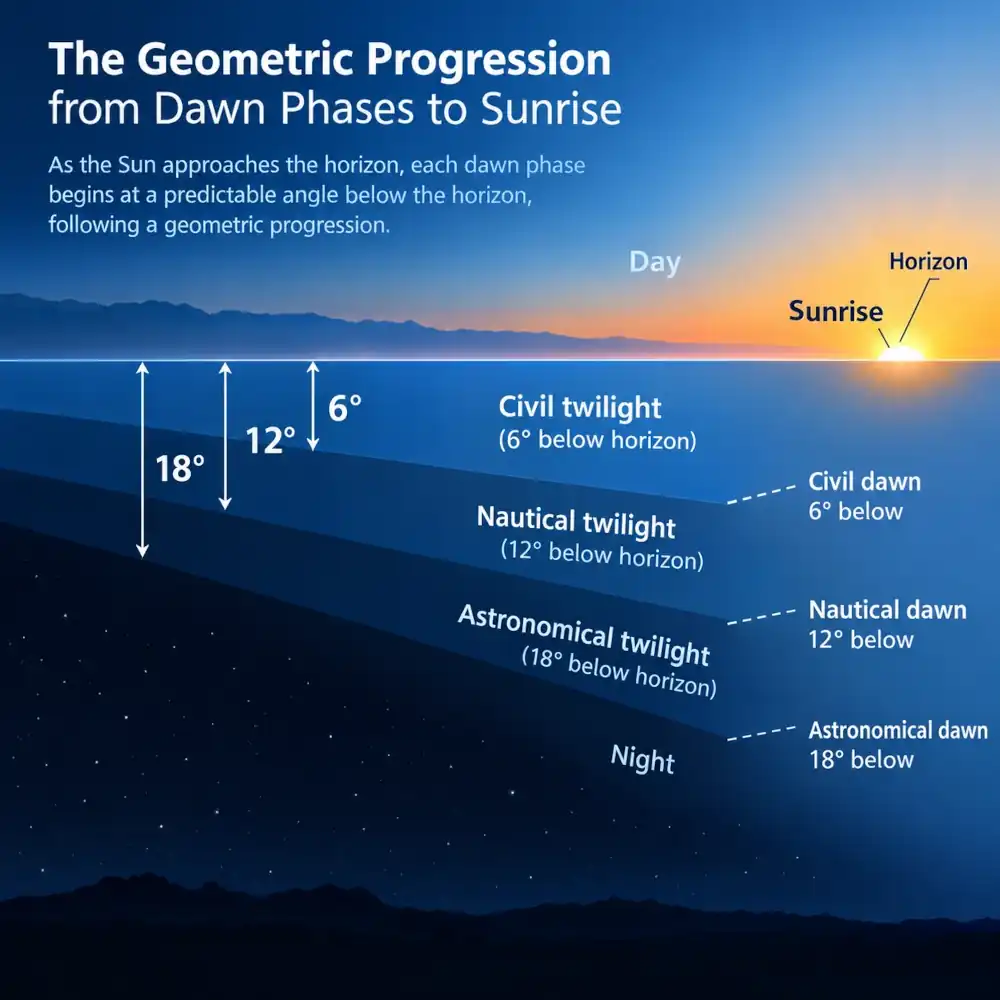
Astronomers divide dawn into three stages, defined by how far the Sun’s center sits below the horizon: 18° for astronomical dawn, 12° for nautical dawn, and 6° for civil dawn. The U.S. Naval Observatory and National Weather Service both use these same boundaries.
The Three Stages of Dawn
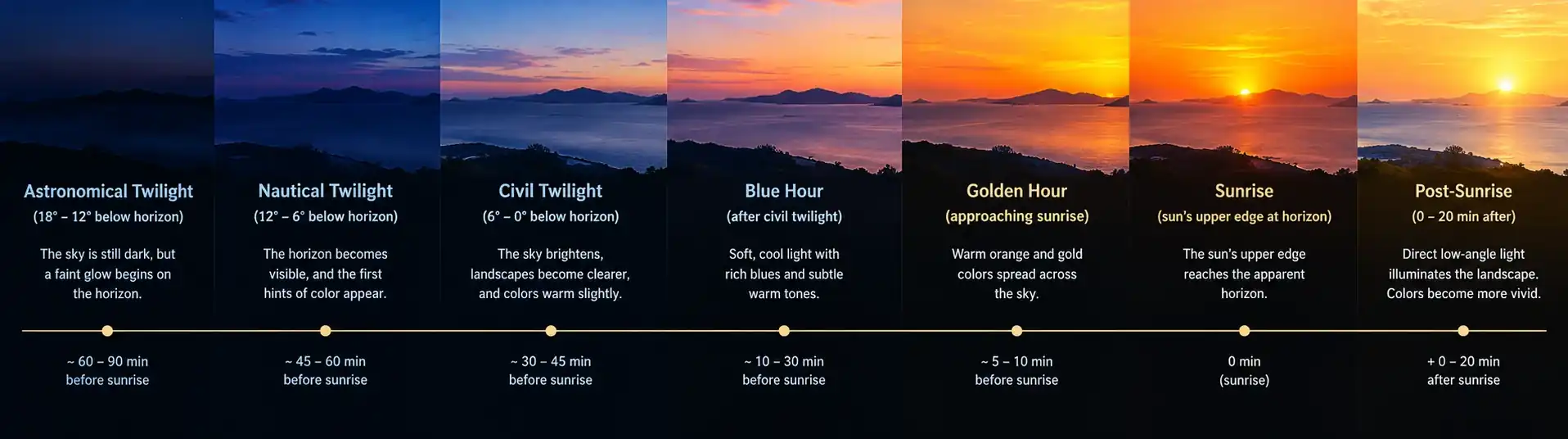
When all three twilight stages occur, the Sun passes through them in this order each morning. The names reflect the traditional uses associated with each level of illumination.
Astronomical Dawn −18°
The faintest stage. The sky can look almost fully dark, especially with light pollution, but it’s no longer as dark as true night — faint objects become harder to observe as it progresses.
Nautical Dawn −12°
The sky brightens noticeably. Under clear conditions the horizon becomes distinguishable while brighter stars remain visible — the combination that made this stage useful for celestial navigation at sea.
Civil Dawn −6°
The brightest stage of dawn. Natural light is usually enough for ordinary outdoor activity in clear weather, though most stars have disappeared and the Sun itself still isn’t visible.
Sunrise ≈ −0.833°
Civil twilight ends and the Sun’s upper edge reaches the apparent horizon — the moment covered in detail below.
Twilight duration isn’t fixed — it depends on latitude, season, solar declination, and the observer’s horizon. Near the equator the Sun crosses the horizon steeply, so the stages pass quickly; near the equinoxes, nautical twilight there lasts roughly 48 minutes. At higher latitudes the Sun’s path meets the horizon at a shallower angle, so each stage takes longer to pass.
What Is Sunrise?
Sunrise is the calculated moment the upper edge of the Sun’s disk reaches the observer’s apparent horizon — a specific event, unlike dawn’s sequence of stages. It is not simply the instant the Sun’s geometric center reaches 0° altitude.
The U.S. Naval Observatory defines sunrise and sunset using a solar-center depression of about 50 arcminutes (0.833°) below the horizontal plane, combining two effects:
- Atmospheric refraction (~34 arcminutes) — light bends as it passes through the atmosphere, making the Sun appear higher than its true geometric position, especially near the horizon.
- The Sun’s apparent radius (~16 arcminutes) — sunrise is timed to the upper edge of the disk, not its center.
So when the Sun’s upper edge appears to touch the horizon at the listed sunrise time, the Sun’s true geometric position is still about 0.833° below it. This is a standard astronomical convention, useful for calculators and almanacs, but it’s an approximation — actual visibility still depends on terrain, weather, and local horizon obstructions.
In the evening, the same sequence runs in reverse: Sunset → Civil Dusk → Nautical Dusk → Astronomical Dusk → Night.
How Long Does Dawn Last?
There’s no universal length for dawn — it depends on latitude, time of year, solar declination, the observer’s horizon, and local atmospheric conditions. At high latitudes, twilight can stretch for hours. Around the summer solstice, some locations never see the Sun drop far enough below the horizon for true astronomical night, and in parts of the far north, even civil twilight can persist through most of the night.
Farther toward the poles, the Sun can stay above the horizon continuously for part of the year — the midnight Sun — rather than producing a daily sunrise and sunset. During polar night, the reverse happens: the Sun stays below the horizon, though twilight can still occur if it comes close enough to it during the local day.
Dawn, First Light, and Sunrise
These get confused because “first light” isn’t a standardized astronomical term, and “dawn” itself is used both broadly and specifically. The National Weather Service commonly uses “dawn” to mean civil dawn specifically, while astronomical sources distinguish astronomical, nautical, and civil dawn as separate stages.
First Light
A descriptive phrase for the earliest visible signs of daylight — not tied to one universal solar angle. What a person actually notices depends on cloud cover, atmospheric clarity, light pollution, terrain, nearby buildings or trees, and their own eyesight. It shouldn’t be treated as a synonym for astronomical dawn.
Sunrise
By contrast, sunrise is the standardized event tied to the Sun’s apparent upper limb reaching the horizon — a precise calculator output, even though the surrounding transition from dark to light is gradual.
Dawn and Sunrise in Everyday Life
Aviation
Civil twilight gives aviation a standardized way to describe the daylight-to-darkness transition. U.S. regulations use published civil-twilight times to define “night” for some purposes — though other aviation rules use different definitions, so civil twilight isn’t a universal substitute for sunrise across every regulation.
Navigation
Nautical twilight matters historically because both the horizon and brighter stars are visible under good conditions — the combination traditional celestial navigation relied on.
Outdoor activities and law
Civil twilight is often more useful than sunrise for judging when natural outdoor visibility begins, though weather, terrain, and artificial lighting still affect it. Some laws and regulations reference sunrise, sunset, or civil twilight specifically — the exact definition depends on the jurisdiction, so it’s worth checking the actual wording rather than assuming the terms are interchangeable.
Religious definitions
“Dawn” also carries specific religious meaning that doesn’t always match the astronomical stages above. Fajr in Islam refers to the prayer time tied to the beginning of true dawn, with calculation methods that vary by tradition. Jewish practice similarly distinguishes concepts like Alot HaShachar and Netz HaChama from one another. These shouldn’t be automatically equated with civil, nautical, or astronomical dawn.
Why Sunrise Times Change Throughout the Year
Sunrise doesn’t happen at the same clock time every day because Earth’s axis is tilted about 23.4° relative to its orbital plane. As Earth travels around the Sun, the Sun’s apparent path across the sky shifts through the year — changing sunrise direction, sunrise time, day length, twilight length, and the Sun’s height at noon. The effect is small near the equator and much larger at higher latitudes.
Common Misconceptions
Not technically — dawn is the twilight transition, sunrise is the specific moment the Sun’s upper limb reaches the horizon. People do use the terms interchangeably in casual speech.
Rayleigh scattering matters most, but aerosols, clouds, and the geometry of sunlight through the atmosphere also shape twilight’s brightness and color.
Duration varies a lot with latitude and season — short near the equator, and up to several hours (or longer) at high latitudes.
Frequently Asked Questions
Is dawn before or after sunrise?
Before. Dawn describes the sky brightening while the Sun is still below the horizon; sunrise comes afterward, once its upper limb reaches the horizon.
How long before sunrise does dawn start?
It depends on latitude and season. Civil dawn sits relatively close to sunrise, while astronomical dawn can begin well over an hour earlier — the gap widens at higher latitudes.
Is dawn the same as first light?
Not exactly — “first light” is an informal description of when someone notices daylight starting, while astronomical dawn has a precise definition based on the Sun’s angle.
Why can I see light in the sky before sunrise?
Sunlight reaches Earth’s upper atmosphere before the Sun clears your local horizon, and atmospheric scattering redirects some of that light down to you — that’s twilight.
Why does sunrise look different from day to day even at the same calculated time?
Clouds, aerosols, humidity, atmospheric clarity, and local terrain all affect the visual experience, even when the astronomical time itself is precise.
Can dawn last all night?
Not literally — dawn is specifically the morning portion of twilight. But at high latitudes, twilight in general can persist all night around the summer solstice, and some locations never reach true astronomical night. In polar regions the Sun can also stay above the horizon continuously for part of the year.
Does dawn happen every day, everywhere?
In most non-polar locations, dawn occurs every morning, though particular twilight stages can be absent at high latitudes during certain seasons. The equivalent evening transition is dusk, not dawn.
Does “sunrise” mean the whole Sun is visible?
No — the sunrise event marks only the upper limb reaching the horizon. The rest of the disk continues rising afterward.
Key Takeaway
Dawn is the gradual brightening before the Sun appears, moving through astronomical (−18°), nautical (−12°), and civil (−6°) stages. Sunrise follows, conventionally calculated for the moment the Sun’s apparent upper limb reaches the horizon — even though, due to refraction and the Sun’s apparent size, its true geometric center is still about 0.833° below the horizon at that instant.