
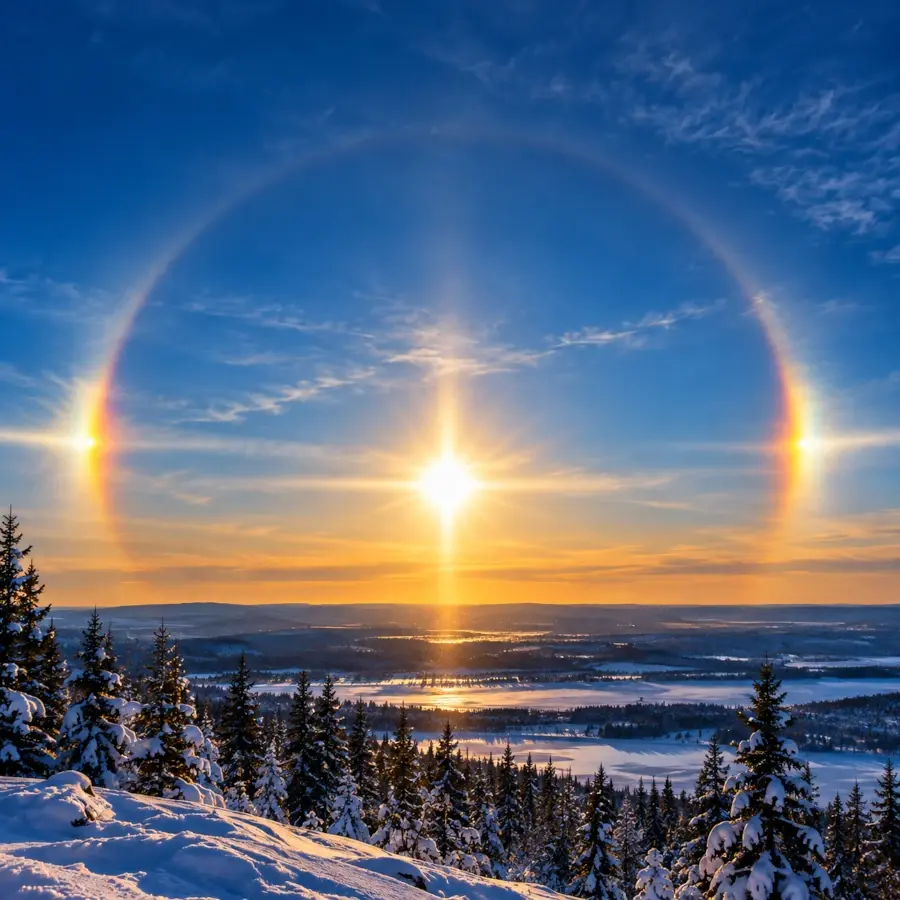
A sun dog is a bright spot of light beside the sun, made when sunlight bends through flat ice crystals in the air. This guide covers how they form, why they are colored, when to look, and how to tell them from other sky halos.
- What a sun dog is
- What a sun dog looks like
- How sun dogs form
- Why sun height matters
- Why you may see only one
- How far away a sun dog is
- When and where to see them
- Sun dogs near the ground
- Viewing safely
- Sun dogs and other halos
- Moon dogs
- Sun dogs and weather
- History and culture
- How to photograph a sun dog
- Observing checklist
- Frequently asked questions
What a sun dog is
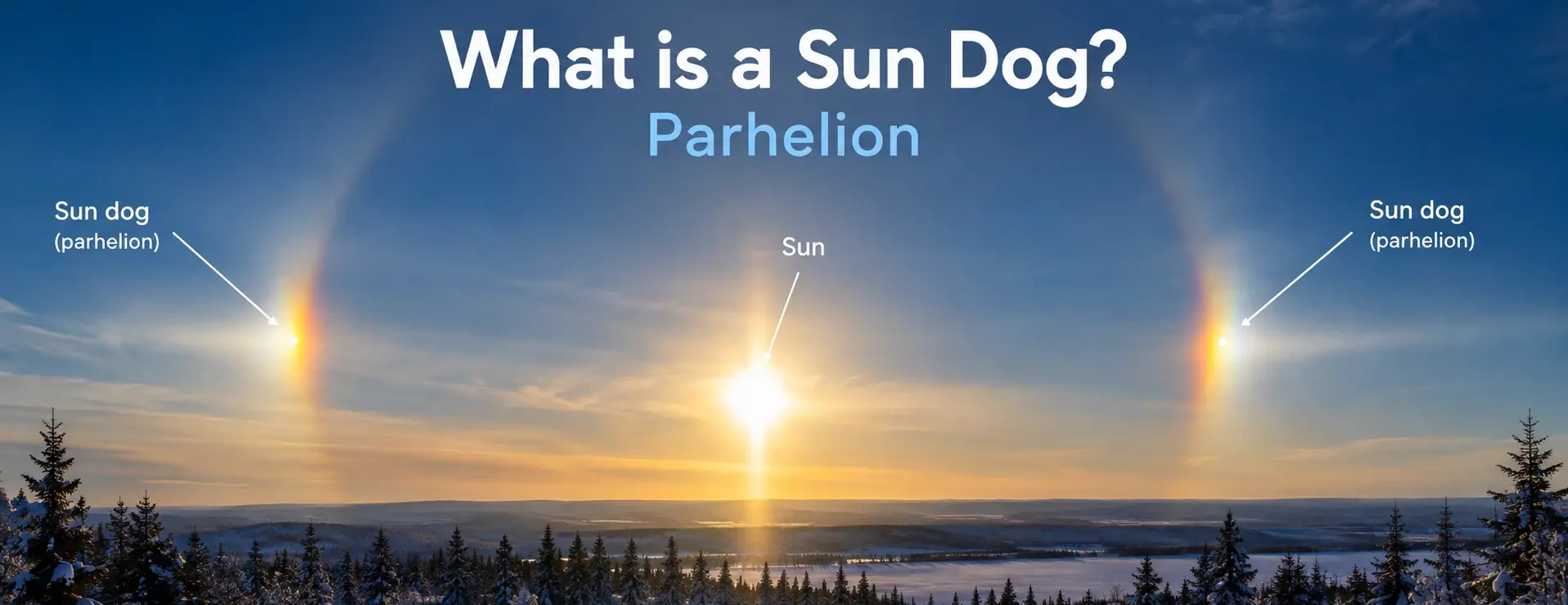
A sun dog, also called a parhelion or mock sun, is a bright patch of light that appears on one or both sides of the sun, at the same height above the horizon and about 22 degrees away from it. It is an atmospheric optical effect, not an object. The light comes from the sun itself, bent by millions of tiny ice crystals floating in thin, high cloud.
The word parhelion comes from Greek words meaning “beside the sun,” and the plural is parhelia. The name “sun dog” is older folk usage. Where it came from is not settled, but the usual explanation is that the two bright spots seem to follow the sun like dogs at its heels.
What a sun dog looks like
A typical sun dog is a small, bright, slightly elongated patch of light, often with a reddish inner edge. At its brightest it can look like a second or third sun, which is why the old term “mock sun” is still used. Faint ones can look like a smudge of pale light beside the sun.
Most sun dogs show some color. The edge closest to the sun is usually red, shading through orange and yellow, and the far edge fades to white or pale blue. Sometimes a long, pale tail of light stretches away from the sun on the outer side of a sun dog. Sun dogs frequently appear as a pair, but one side is often brighter, and sometimes only one is visible because the cloud is patchy.
How sun dogs form
Sun dogs are a refraction effect. Refraction is the bending of light as it passes from one material into another, and ice bends light more than air does. To make a sun dog, the ice has to be in the right shape and in the right orientation.
Plate crystals and how they fall
High, cold cloud is made of ice rather than water droplets. Some of those crystals grow as thin, flat, six-sided plates. Thin plate-shaped ice crystals often fall with their broad faces approximately horizontal, although their orientations vary and they wobble as they fall. That preferred alignment is what lets them produce concentrated sun dogs rather than only a diffuse halo. It takes a population of crystals with a preferred orientation, not perfectly aligned ones.
The 60 degree prism and the 22 degree angle
Sunlight entering and leaving two suitable side faces of a hexagonal ice crystal passes through a prism angle of 60 degrees. For the relevant ray paths, the minimum deviation is approximately 22 degrees, measured between the direction of the incoming ray and the direction of the outgoing ray. When many plate-shaped crystals have their faces roughly horizontal, they concentrate refracted sunlight into bright patches on either side of the sun. Rays near minimum deviation contribute strongly to the inner edge of each sun dog, but the display spans a range of angles rather than forming a point exactly 22 degrees from the sun.
Why red is on the inside
Ice bends blue light slightly more than red light. Red therefore has the smallest bend and lands closest to the sun, and blue lands farther out. That gives the red inner edge and the pale blue outer edge. Because the different colors overlap, the separation is usually weak.
Side-on view of one ray through a 60° prism at minimum deviation. The dashed line continues the incoming ray, and the angle to the outgoing ray is the deviation, about 22°. The sun, crystal and observer are not to scale, and a real display combines rays from millions of crystals.
Why sun height matters
The 22 degree figure applies when the sun is low. As the sun climbs, the angular distance between the sun and each sun dog increases, and the sun dog usually becomes fainter and harder to separate from the brightening sky. How much it shifts depends on the sun’s elevation and on how the crystals are oriented, so treat 22 degrees as a low-sun figure, not a constant. Sun dogs are most striking when the sun is fairly low, and high-sun sun dogs are weaker and easy to miss.
A sun dog always sits at the same height above the horizon as the sun. Once you know where the sun is, scan sideways along that level. At arm’s length, 22 degrees is roughly two fists on either side of the sun.
Why you may see only one
Many displays are lopsided. Cloud may cover one side of the sky, the suitable plate crystals may not be spread evenly through the cloud, or their orientation may favor one side more than the other. Seeing one bright sun dog does not mean something went wrong with the other. Check the opposite side for a fainter one, and if the cloud is patchy, wait a few minutes and look again.
How far away a sun dog is
A sun dog is not an object at a fixed distance. The 22 degrees is an angle measured across the sky, not a distance in kilometers. What you see is sunlight bent by ice crystals in the atmosphere, and the bright patch appears wherever those crystals are positioned along your line of sight. Two observers a few kilometers apart see slightly different sun dogs, made by different crystals.
When and where to see them
Look when two things are true: the sun is fairly low, and there are suitable ice crystals in the air. The most common source is thin, high cloud that looks like a pale veil or fine wispy streaks, not a thick gray layer. Sunrise and the hour or two after, or the last couple of hours before sunset, are the best windows.
Sun dogs can appear anywhere in the world and in any season, because ice crystals form in high cloud even in summer. They are noticed more often in cold regions, where ice cloud can form lower, and where low winter sun gives you more chances to look.
Sun dogs near the ground
Sun dogs are not restricted to high cloud. In very cold, calm conditions, tiny ice crystals can hang in the air close to the surface in a glittering haze called diamond dust. If those crystals are plates, they can produce sun dogs and other halos in a sky that looks clear or nearly clear. That is why a display can appear without any obvious high cloud, especially on a frigid morning with low sun.
Viewing sun dogs safely
Never look directly at the sun to find or observe a sun dog. A sun dog appears close to the sun, and viewing the sun can damage your eyes, sometimes without immediate pain. Keep the sun completely hidden behind a building, tree trunk, or other solid object while you observe. Ordinary sunglasses are not safe for looking at the sun. Never point a camera, binoculars, or telescope toward the sun without a proper solar filter fitted over the front of the instrument. If the sun cannot be safely hidden, view the display through photographs instead.
Sun dogs and other halos
Sun dogs are one member of a family of halo effects caused by ice crystals. If you see a sun dog, scan the sky for others, because the same cloud often produces several at once. Here is how the common ones compare.
| Halo effect | What it looks like | Where it appears | What forms it | How to tell it apart |
|---|---|---|---|---|
| Sun dog (parhelion) | Bright spot, often with a red inner edge | Level with the sun, usually near 22° when the sun is low | Plate crystals with faces roughly horizontal | A spot, not a ring, beside the sun |
| 22° halo | Complete or partial ring around the sun | About 22° from the sun in every direction | Randomly oriented hexagonal crystals | A ring, with a sharp reddish inner edge |
| 46° halo | Larger, fainter ring | About 46° from the sun | Hexagonal crystals, commonly randomly oriented | Much larger than the 22° halo and usually faint |
| Upper tangent arc | V-shaped or bowed arc | Touching the top of the 22° halo | Horizontally oriented column crystals | An arc sitting on top of the halo |
| Circumzenithal arc | Bright rainbow-colored arc | High above the sun, when the sun is fairly low | Plate crystals with faces roughly horizontal | Curves away from the sun, like an upside-down rainbow |
| Parhelic circle | Faint white horizontal band | A horizontal circle through the sun, at the sun’s height | Mainly reflection from vertically oriented crystal faces | A level white band, not colored |
| Sun pillar | Vertical column of light | Above or below a low sun | Plate crystals reflecting light | A vertical shaft, usually at sunrise or sunset |
The quickest test: a sun dog is a bright spot at the sun’s height, a 22 degree halo is a ring, and a circumzenithal arc is a colored arc well above the sun. When the halo is complete, sun dogs sit on or just outside the ring, depending on the sun’s height, so the ring and the sun dogs do not share an identical fixed radius under all conditions.
Moon dogs
The same physics works at night. A moon dog, or paraselene, is a sun dog made by moonlight, and it appears about 22 degrees from the moon. They are much rarer because they need a bright moon, usually close to full, and thin ice cloud at the same time. Moonlight is also too dim for our eyes to see color well, so moon dogs almost always look white. A photograph with a long exposure will often show faint color that the eye misses.
Sun dogs and weather
An old weather saying links sun dogs to coming rain or snow. There is a loose basis for it. Sun dogs form in cirrus and cirrostratus cloud, and those clouds often spread ahead of an approaching warm front, where weather can turn within a day or so.
But the link is weak. Thin ice cloud also forms without any front behind it, and a front can bring weather with no halo display. Treat a sun dog as a reason to check a forecast, not as a forecast.
History and culture
Sun dogs have been recorded for a very long time. Aristotle discussed mock suns in his writing on the weather, and later natural philosophers, including Descartes, tried to explain them with geometry. Medieval and early modern chroniclers often treated halo displays as omens.
The best-known historical record is a Swedish painting called Vädersolstavlan, or “the Sun Dog Painting,” in Storkyrkan, Stockholm Cathedral. It depicts a halo display seen over Stockholm on April 20, 1535, with several sun dogs and arcs. The painting you can see today is a 1636 copy by Jacob Heinrich Elbfas of a lost original, which is attributed to Urban Målare and linked to Bishop Olaus Petri. It is often described as the oldest depiction of Stockholm. In the political and religious tensions of Gustav Vasa’s reign, displays like this one were read by some as warnings of divine anger. See the Atmospheric Optics write-up of the 1535 display for an analysis of the halos the painting shows.
How to photograph a sun dog
Sun dogs photograph well, and a camera lets you study one without staring at the sky. Low sun is also prime golden hour light, so the timing works in your favor. Hiding the sun helps with glare and composition, but it does not make every camera setup safe, so read the safety section above first. Then use these steps.
- Use a wide-angle lens. A phone’s wide setting works, because you need to capture the sun dog and the area around it.
- Keep the sun hidden behind a pole, tree trunk, roof edge, or building, so the sun is not in the frame and not in your line of sight.
- Do not aim a camera, binoculars, or a telescope directly at the sun without a proper solar filter.
- Lower the exposure. Set it for the bright sky rather than the dark foreground, then check that the colors are not blown out.
- Add a foreground such as a tree line, a building, a road, or a person. It gives the sun dog scale.
- A polarizing filter can darken the sky and raise contrast, but its effect on halos depends on its angle, so rotate it and compare.
Observing checklist
Frequently asked questions
What is a sun dog?
A sun dog, or parhelion, is a bright spot of light that appears on one or both sides of the sun, level with it and usually about 22 degrees away when the sun is low. It is caused by sunlight refracting through flat, plate-shaped ice crystals.
What causes a sun dog?
Sunlight enters one side face of a hexagonal ice plate and leaves through another face tilted 60 degrees from the first. That path bends the light by a minimum of about 22 degrees, so light piles up near that angle from the sun. The plates must be falling with their broad faces roughly horizontal, though not perfectly so.
Why is it called a sun dog?
The origin of the name is uncertain. Sun dogs appear to accompany the sun on either side, and the usual explanation is that they follow it like dogs at its heels. The scientific name, parhelion, comes from Greek words meaning beside the sun.
Are sun dogs rare?
No. Sun dogs are one of the most commonly seen halo displays, and many people see them without noticing. They are easiest to spot when the sun is fairly low and thin ice-crystal cloud covers part of the sky.
Why do I only see one sun dog?
Displays are often lopsided. Cloud may cover one side of the sky, the suitable plate crystals may not be spread evenly, or their orientation may favor one side. A single bright sun dog does not mean the other is missing for any special reason.
Do sun dogs mean bad weather is coming?
Not reliably. Sun dogs form in ice-crystal cloud such as cirrus and cirrostratus, and that cloud often thickens ahead of an approaching warm front, which can bring rain or snow within a day or so. But the same cloud sometimes forms with no weather behind it, so a sun dog is a hint, not a forecast.
What is the difference between a sun dog and a halo?
A sun dog is itself a kind of halo phenomenon, which is the general name for optical effects made by ice crystals. When people say halo, they usually mean the 22 degree halo, a ring around the sun. A sun dog is a bright spot beside the sun, and needs flat plates with a preferred orientation, while the ring forms mainly from randomly oriented crystals.
Why are sun dogs colored?
Ice bends red light slightly less than blue light. That puts red on the side of the sun dog nearest the sun, with orange and yellow beyond it, and a whiter blue edge on the far side. The colors overlap, so many sun dogs look mostly white.
What is a moon dog?
A moon dog, or paraselene, is the same effect made by moonlight, and it appears about 22 degrees from the moon. Moon dogs are much rarer and fainter than sun dogs. They need a bright moon, usually near full, and thin ice-crystal cloud, and they usually look white because moonlight is too dim for color vision.
How far away is a sun dog?
A sun dog is not an object at a fixed distance. The 22 degrees is an angle measured across the sky, not a distance in kilometers. What you see is sunlight bent by ice crystals in the atmosphere, which are often several kilometers above the ground.
Is it safe to look at a sun dog?
Never look directly at the sun. A sun dog sits close to the sun, which can damage your eyes, and ordinary sunglasses do not make direct sun viewing safe. Keep the sun hidden behind a building, tree trunk, or other solid object while you observe, and use photographs if you cannot hide it.