

The Sun's visible surface is about 5,500 °C (9,940 °F), its core reaches about 15 million °C (27 million °F), and its outer atmosphere, the corona, is hotter than 1 million °C (1.8 million °F). Temperature changes sharply from layer to layer, and the hottest part of the Sun is its core, which you can never see.
The glowing surface we see at sunrise and sunset is thousands of degrees cooler than the layers above and below it. This guide walks through every layer of the Sun, explains how scientists measure temperatures nobody can reach with a thermometer, and shows why a million-degree atmosphere does not melt a spacecraft.
Temperature of each layer of the Sun
The Sun is a ball of hot plasma with no solid surface. Its layers are defined by what happens inside them, and each has a very different temperature. The diagram below shows the layers in order. Colors match the table.
Cross-section of the Sun, not to scale. The outer layers are drawn thicker than they really are so they are visible.
| Layer | Approximate temperature (°C) | Approximate temperature (°F) |
|---|---|---|
| Core | 15 million | 27 million |
| Radiative zone | Falls from about 7 million to about 2 million | Falls from about 12.6 million to about 3.6 million |
| Convection zone | Falls from about 2 million to about 5,500 | Falls from about 3.6 million to about 9,940 |
| Photosphere (visible surface) | About 5,500 | About 9,940 |
| Chromosphere | About 4,000 to 30,000 | About 7,200 to 54,000 |
| Transition region | Rises steeply from about 10,000 to about 1 million | Rises steeply from about 18,000 to about 1.8 million |
| Corona | About 1 to 3 million | About 1.8 to 5.4 million |
| Sunspots (dark patches on the photosphere) | About 2,700 to 4,200 | About 4,900 to 7,600 |
These are broad, rounded values, not one fixed temperature throughout each layer. Solar flares are a separate case. Their temperatures vary widely, and the hottest regions of a large flare can exceed 10 million °C (18 million °F).
The hottest part of the Sun is the core. For reference figures, see NASA's Sun facts and the NASA Sun fact sheet.
How hot is the surface of the Sun?
The visible surface, called the photosphere, averages about 5,500 °C (9,940 °F). Astronomers often quote the Sun's effective temperature as 5,772 kelvin, the temperature a perfect glowing object would need to match the total light the Sun gives off.
The Sun is often drawn yellow, but it emits all visible colors and looks white from space. Earth's atmosphere scatters the blue end of that light, which is why a low Sun looks orange or red. You can see that effect during golden hour, and you can read more about the Sun's first light in our guide to how long sunrise lasts.
Sunspots look dark only by contrast. They are often quoted at about 3,000 to 4,500 kelvin, which is roughly 2,700 to 4,200 °C. That is cooler than the surrounding photosphere, and a sunspot on its own would still glow brightly.
How hot is the Sun's core?
The core reaches about 15 million °C (27 million °F). Some references quote about 15.7 million kelvin. At that temperature and under crushing pressure, hydrogen nuclei fuse into helium and release the energy that powers the Sun. The Sun converts roughly 4 million tonnes of matter into energy every second.
That energy takes a very long time to reach the surface. NASA's educational material describes radiation crossing the radiative zone over roughly 170,000 years, and other estimates run to several hundred thousand years depending on what is measured. The number is not a simple trip time for one particle. Energy is absorbed and re-emitted countless times on the way out. Once sunlight leaves the surface, it needs only about 8 minutes and 20 seconds to reach Earth.
Why is the corona hotter than the surface?
The corona, the Sun's thin outer atmosphere, runs from about 1 to 3 million °C (1.8 to 5.4 million °F), with some regions hotter. It sits above a surface of only about 5,500 °C, which seems to break the rules. This is one of the best-known open problems in solar physics.
Two leading explanations involve magnetic waves and many tiny magnetic explosions, often called nanoflares, that deposit energy into the thin gas. Neither is a fully settled answer. NASA's Parker Solar Probe has flown through the corona to measure it directly and help settle the question.
You see the corona from Earth only during a total solar eclipse, when the Moon blocks the bright surface.
How do scientists measure the Sun's temperature?
Nobody can put a thermometer into the Sun, so each layer is measured a different way.
- Photosphere: scientists work out the effective temperature from the Sun's total brightness, its size and distance, and the spectrum of its light.
- Solar atmosphere: spectroscopy splits sunlight into wavelengths. Atoms and ions in the chromosphere and corona emit light at specific wavelengths, and which ones appear reveals the temperature of the plasma.
- Interior: the core cannot be seen, so scientists use solar models built on nuclear physics and compare them with helioseismology, the study of sound-like vibrations that travel through the Sun. Neutrinos from the core give another check on the fusion rate.
The interior values are therefore model-based estimates that observations constrain, not direct readings. You can try the spectral method yourself in the live viewer below.
See the Sun's layers right now
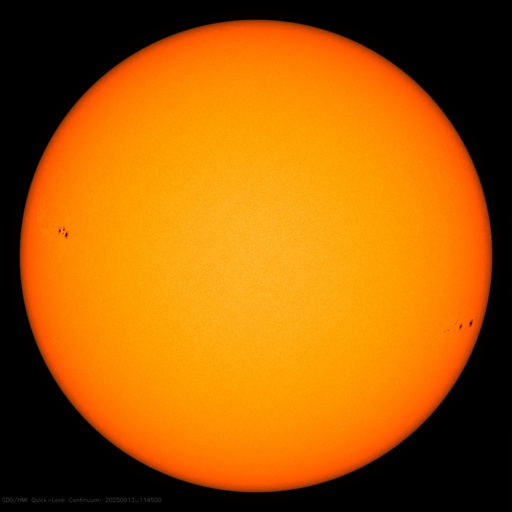
Each image below is a live view from NASA's Solar Dynamics Observatory, taken in a different wavelength of light. Atoms in the Sun emit specific wavelengths only at specific temperatures, so every image shows a different layer. Switch between them to compare the surface with the atmosphere above it.
Solar wind temperature
--
°C, measured near Earth
Solar wind speed
--
km/s
Solar wind density
--
particles per cm³
The solar wind is a stream of charged particles flowing out from the corona. These readings come from a satellite about 1.5 million km sunward of Earth. By the time the wind arrives, it has cooled to roughly 100,000 °C, far below the million-degree corona it left. Sun images: NASA/SDO and the AIA and HMI science teams. Wind data: NOAA Space Weather Prediction Center.
In the 193 Å and 94 Å images, the bright areas are the corona and the hottest active regions, while the visible-light image shows the cooler surface and its dark sunspots. This is the same temperature structure as the layers table above, seen directly. Bright flashes in the 94 Å image often mark solar flares.
Why doesn't the million-degree corona melt spacecraft?
Temperature and heat are different things. Temperature measures how fast particles are moving on average. Heat is energy transferred from one object to another.
The corona is extremely hot but extremely thin. It has very few particles per cubic meter, so there is little material to hand energy to a passing object. A spacecraft flying through it receives far less heat than the temperature alone suggests. A good analogy is an oven: you can briefly put your hand in air at 200 °C, but you cannot touch a pan at the same temperature.
The bigger heat source is sunlight itself. Parker Solar Probe carries a carbon-composite heat shield, and NASA states that the sunward side of the shield reaches about 1,400 °C (2,500 °F) near closest approach, while the instruments behind it stay near room temperature.
How the Sun compares to familiar heat and other stars
Everyday temperatures and astronomical temperatures live on very different scales. The chart below uses a logarithmic scale, so each step to the right is a tenfold increase. On a normal linear scale, the core would dwarf everything else and the other bars would be invisible.
Logarithmic scale. Bar lengths are not proportional to temperature.
- Boiling water: the Sun's visible surface is about 5,500 °C, compared with 100 °C for boiling water.
- Lava: roughly 700 to 1,200 °C.
- Lightning: a channel can briefly reach around 30,000 °C, hotter than the Sun's photosphere. A bolt is tiny and lasts a fraction of a second, so it carries vastly less energy than the Sun.
- Earth's inner core: thought to be roughly 5,000 to 6,000 °C, similar to the Sun's surface. The hottest air temperature ever recorded on Earth's surface is 56.7 °C (134 °F).
Is the Sun the hottest star?
No. The Sun is an ordinary, medium-temperature star. Red dwarfs are cooler, with surface temperatures around 2,500 to 3,500 °C. Yellow stars like the Sun sit in the middle. Hot blue stars can exceed 30,000 °C at the surface. These are surface temperatures. Core temperatures are far higher in every case.
Why Earth does not burn
Distance does most of the work. Earth sits about 93 million miles (150 million km) from the Sun and catches only a tiny share of its output. At the top of the atmosphere, sunlight delivers roughly 1,361 watts per square meter. Our atmosphere, clouds and oceans then absorb, reflect and spread that energy, which keeps the global average surface temperature near 15 °C (59 °F).
Space itself is not a hot environment because it contains almost no matter, but an object in direct sunlight there can still become very hot. Radiation crosses a vacuum without needing air, and the object absorbs it. Satellites and astronauts can face extreme swings between sunlit and shaded sides, which is why spacecraft use insulation, reflective coatings and radiators.
The Sun's activity affects us in other ways. Flares and coronal mass ejections can disturb satellites and power grids, and the NOAA Space Weather Prediction Center publishes forecasts and alerts.
Does the Sun's temperature change?
Through the year
The Sun's output barely changes over a year, and Earth's seasons are not caused by distance. Earth is actually farthest from the Sun in early July. Seasons come from the tilt of Earth's axis, which changes how directly sunlight strikes each hemisphere. To see how that works, read our guides to what a solstice is and what the equinox is.
The same tilt controls how high the Sun climbs each day. That peak happens at solar noon, and it also explains why sunrise time changes every day.
Over the solar cycle
The Sun runs through an activity cycle of about 11 years, with more sunspots, flares and eruptions at solar maximum. Three things are easy to confuse here. Solar activity changes a lot over the cycle. Total solar irradiance, the energy reaching Earth, changes only by roughly 0.1%. The Sun's core and photosphere temperatures do not swing dramatically at all.
More of our sunrise and sky guides are on the sunrise blog. For light effects, see our post on sun dogs.
Key takeaways
Core: about 15 million °C (27 million °F), the hottest part of the Sun.
Surface: about 5,500 °C (9,940 °F), the part we see.
Corona: about 1 to 3 million °C (1.8 to 5.4 million °F), very hot but very thin, which is why spacecraft can survive it.
Frequently asked questions
How hot is the Sun in Fahrenheit?
The Sun's surface is about 9,940 °F, its core is about 27 million °F, and its corona is above 1.8 million °F.
How hot is the Sun in Celsius?
The surface is about 5,500 °C, the core is about 15 million °C, and the corona is 1 to 3 million °C.
Is the Sun's core or surface hotter?
The core is far hotter, at about 15 million °C compared with about 5,500 °C at the surface. The corona, the outer atmosphere, is also much hotter than the surface.
Why is the Sun's atmosphere hotter than its surface?
Scientists think magnetic waves and tiny magnetic explosions heat the corona. The exact mechanism is still being studied, and spacecraft such as Parker Solar Probe are collecting data to help answer it.
What color is the Sun?
The Sun is white. It looks yellow, orange or red from Earth because the atmosphere scatters shorter blue wavelengths, especially when the Sun is low near sunrise and sunset.
How long does it take sunlight to reach Earth?
Sunlight takes about 8 minutes and 20 seconds to travel the roughly 93 million miles from the Sun to Earth.
How do scientists measure the temperature of the Sun?
They cannot use a thermometer. The surface temperature comes from the Sun's brightness and light spectrum, the atmosphere's temperature from spectroscopy of light emitted by atoms and ions, and the interior from solar models checked against helioseismology.
Is lightning hotter than the Sun?
A lightning channel briefly reaches about 30,000 °C, which is hotter than the Sun's 5,500 °C surface. Lightning is tiny and short-lived, so it carries far less total energy than the Sun.
Why doesn't the Sun's corona melt spacecraft?
The corona is extremely hot but very thin, so it has few particles to transfer heat to a spacecraft. Temperature and heat are different things. Parker Solar Probe also uses a heat shield to protect its instruments from direct sunlight.
Does the Sun get hotter in summer?
No. The Sun's output changes by only about 0.1% over its 11-year cycle. Summer is warmer because Earth's axial tilt makes sunlight hit your hemisphere more directly, and Earth is actually farthest from the Sun in early July.