What is the Equinox
Twice a year, headlines announce that day and night are “equal” everywhere on Earth. It’s a tidy idea — and it’s not quite true.
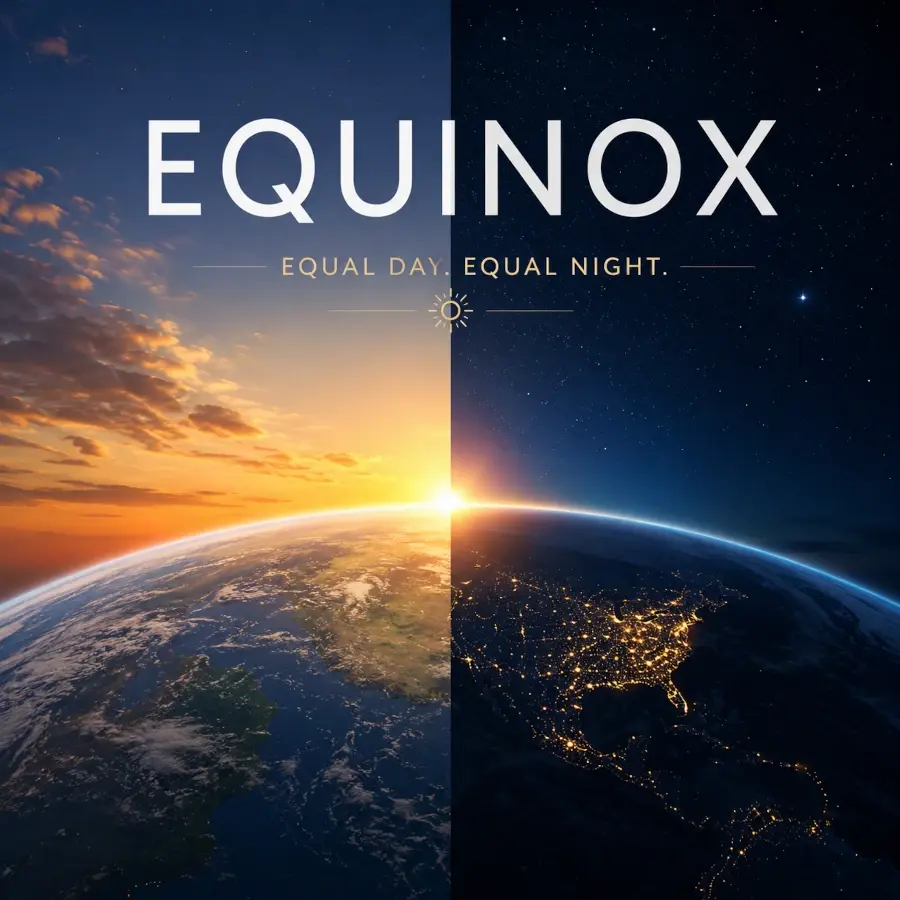
At the equinox, Earth’s tilt points neither toward nor away from the sun — so the day/night line (terminator) runs straight through both poles instead of cutting across at an angle, as it does at the solstice.
Quick answer
An equinox is a single instant — not a whole day — when the sun crosses the celestial equator. Every location on Earth gets close to 12 hours of daylight and 12 of night, and the sun rises due east and sets due west everywhere on the planet.
- 01What Actually Happens
- 02Why “Equal Night” Isn’t Perfect
- 03March vs. September
- 04Equinox vs. Solstice
- 05Why the Date Shifts
- 06At Sunrise and Sunset
- 07Where the Word Comes From
- 08Does It Look the Same Everywhere
- 09The Egg-Balancing Myth
- 10Track the Sky With It
What Actually Happens During an Equinox
Earth’s axis is tilted about 23.4° relative to its orbit around the sun. Most of the year, that tilt points one hemisphere more toward the sun and one away from it — which is why the Northern and Southern Hemispheres have opposite seasons.
Twice a year, Earth reaches a point in its orbit where the tilt is angled neither toward nor away from the sun — it points sideways, along the direction of travel. At that instant, sunlight strikes the equator most directly, and the terminator runs straight through the North and South poles instead of cutting across at an angle, as shown above.
Because that day-night line is vertical relative to the equator, every latitude on Earth is briefly split close to evenly between the sunlit half and the dark half — which is where “equal day and night” comes from.
Why “Equal Night” Isn’t Perfectly Equal
In practice, most places see slightly more than 12 hours of daylight on the equinox, not exactly 12. Two things throw off the perfect split:
- Atmospheric refraction. Earth’s atmosphere bends sunlight, so the sun becomes visible slightly before it’s geometrically at the horizon, and stays visible slightly after. This adds a few extra minutes of apparent daylight.
- How sunrise and sunset are defined. Both are measured from the top edge of the sun’s disk, not its center. Since the sun has measurable width, it takes a couple of minutes for the whole disk to clear the horizon — time that counts as daylight even though the sun’s center hasn’t technically risen yet.
The date with true 12-hour day and 12-hour night — called the equilux — actually falls a few days before the spring equinox and a few days after the fall equinox in most mid-latitude locations.
March vs. September: The Two Equinoxes
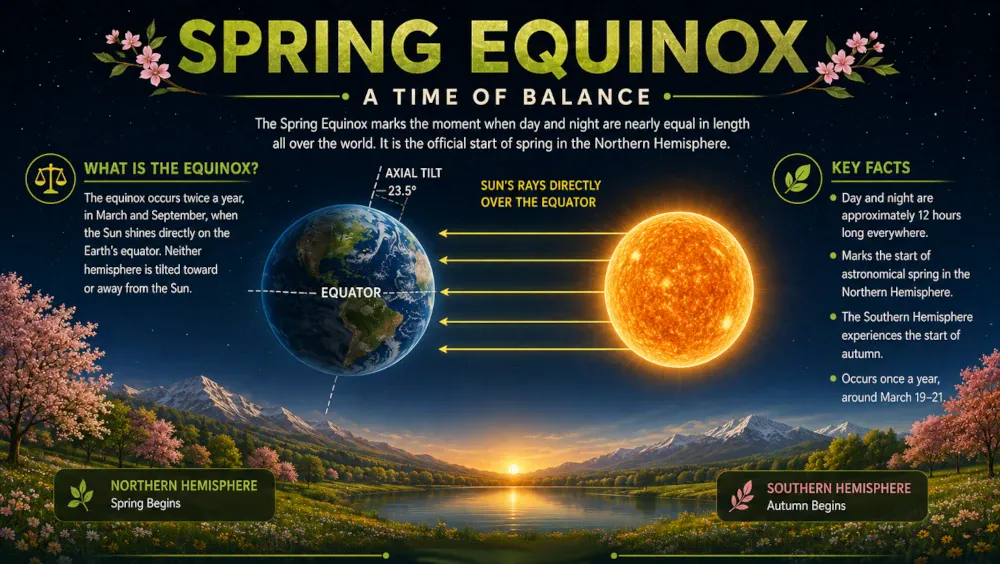
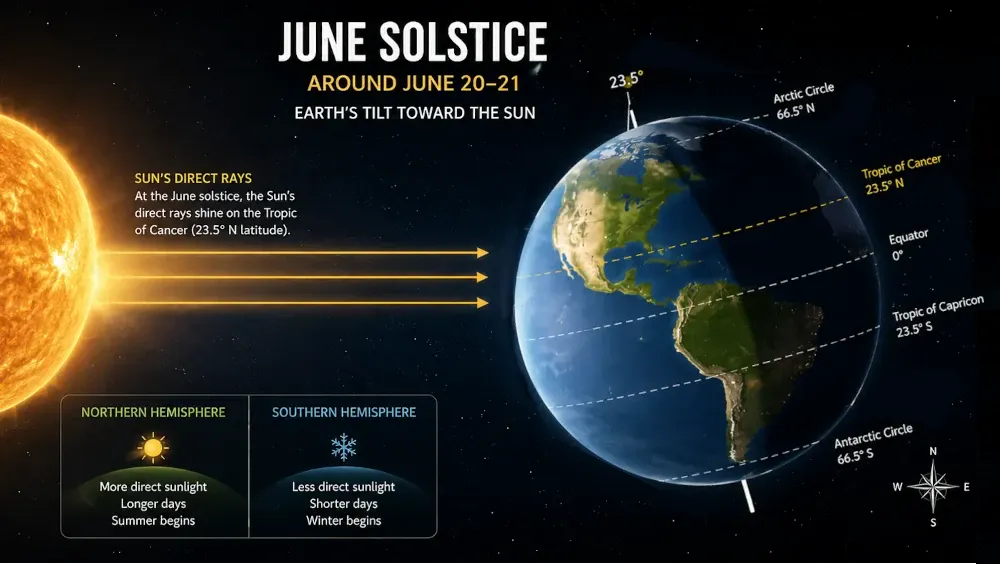
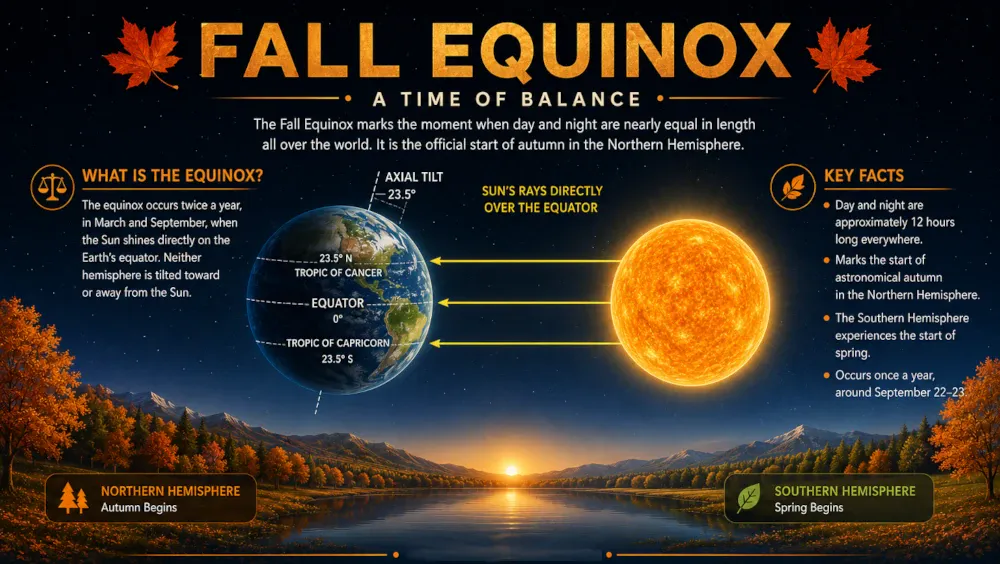
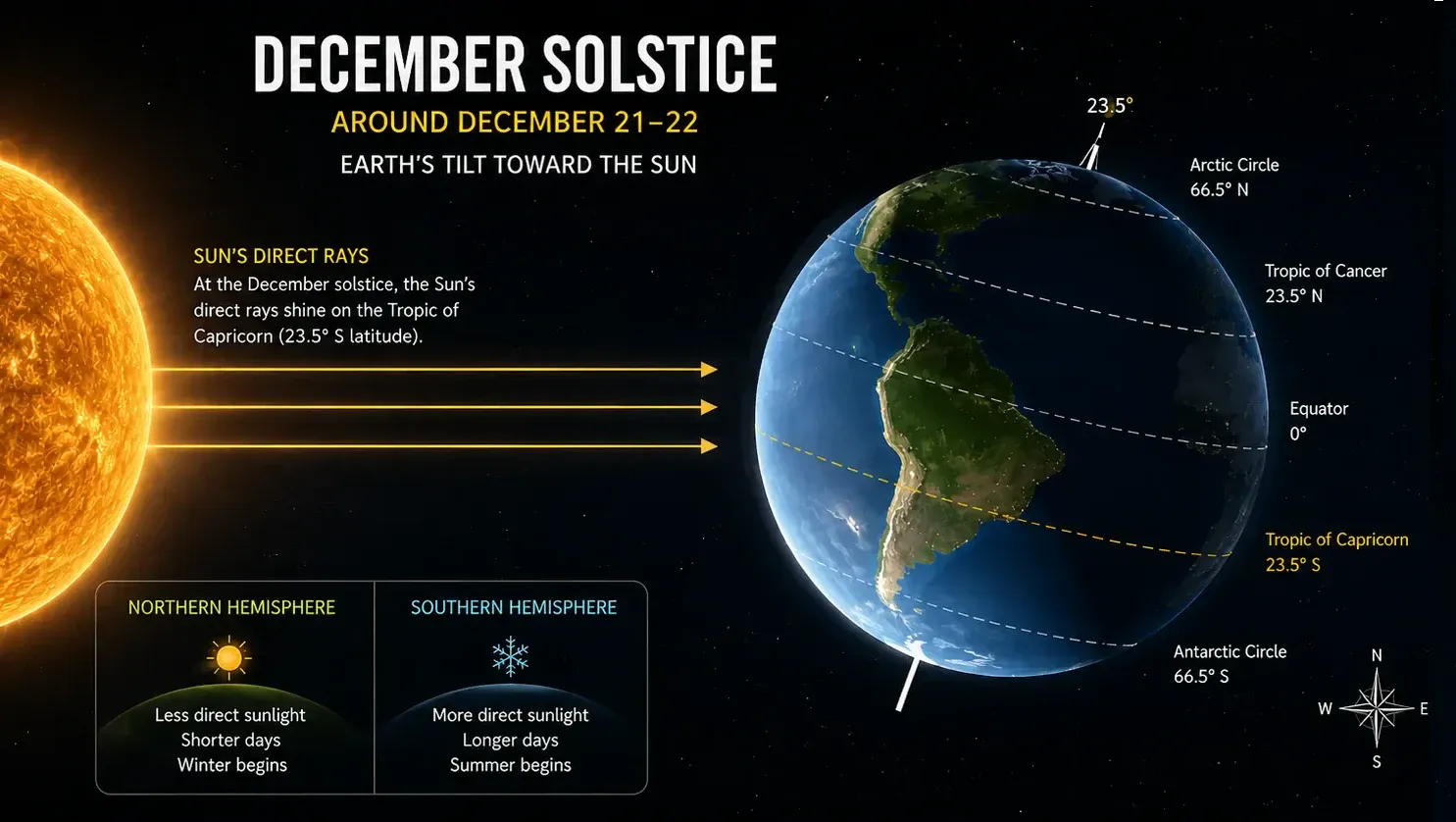
Both equinoxes are astronomically identical events — the only difference is which hemisphere is transitioning into longer days versus shorter ones afterward.
Equinox vs. Solstice
It’s easy to mix these up:
- Equinox — the sun crosses the equator; day and night are close to equal worldwide; the sun rises due east and sets due west.
- Solstice — the sun reaches its farthest point north or south of the equator; one hemisphere gets its longest day of the year, the other its shortest.
Between an equinox and the following solstice, the sun’s rise and set points drift steadily along the horizon, and daylight length changes fastest right around the equinox itself — which is also why sunrise and sunset times shift more quickly in March and September than they do in June or December.
Why Equinoxes Don’t Fall on the Same Date Every Year
The equinox is tied to Earth’s position in orbit, not to the calendar. Because a calendar year (365 days) doesn’t divide evenly into the time Earth actually takes to orbit the sun (about 365.24 days), the exact date and time of the equinox drifts slightly year to year, sliding across a roughly four-day range before leap years reset it.
What You’ll Notice at Sunrise and Sunset
The equinox is one of the few days of the year you can use the sunrise itself as a compass: no matter where you’re standing on Earth, the sun comes up almost exactly due east and sets almost exactly due west. It’s a useful reference point for photographers and hikers tracking the sun’s rise position through the seasons — on the solstices, that same point on the horizon will have swung as far north or south as it goes all year.
If you photograph the sunrise from the same spot on both equinoxes, and then again on both solstices, you end up with four points along the horizon that map out the sun’s entire annual range — a simple, repeatable project that doubles as a way to actually see the tilt of the Earth doing its work, rather than just reading about it.
Where the Word “Equinox” Comes From
The word traces back to the Latin aequus (“equal”) and nox (“night”) — literally “equal night.” Latin and Greek astronomers had already worked out the basic mechanics of the event more than two thousand years ago, tracking the sun’s position against the background stars well enough to predict the crossing point even without any instrument more advanced than a marked stick and a shadow.
Many ancient structures were built with the equinox in mind, not just the solstices. At Chichén Itzá in Mexico, the afternoon light on the spring and fall equinox falls on the staircase of El Castillo in a way that appears to create a moving serpent shadow slithering down the pyramid — a deliberate piece of architectural astronomy, not a coincidence. Stonehenge, the temples of ancient Egypt, and countless other equinox-aligned structures point to the same conclusion: long before anyone understood orbital mechanics, people were watching the sky closely enough to notice the pattern and build around it.
Does the Equinox Look the Same Everywhere?
The astronomy is identical everywhere on Earth, but the experience of the day isn’t. Near the equator, day length barely changes across the year at all, so the equinox passes almost unnoticed — every day is close to 12 hours regardless of the season. The closer you get to the poles, the more dramatic the shift around the equinox becomes, since that’s the point in the year when day length is changing fastest.
Inside the Arctic and Antarctic Circles, the equinox marks something more specific: it’s roughly the date the sun starts staying above the horizon continuously (heading into summer) or starts dropping below it entirely (heading into winter). For high-latitude locations, the equinox isn’t just a symbolic midpoint — it’s close to the actual hinge between months of continuous daylight and months of continuous darkness.
The Egg-Balancing Myth
A persistent bit of equinox folklore claims that an egg can only be balanced on its end on the day of the equinox, thanks to some special gravitational alignment. It isn’t true. An egg’s ability to balance on its end has to do with its shape and the texture of its shell meeting a surface, not with the sun’s position — and it can be done on any day of the year with enough patience. The myth likely survives because people are more inclined to try the trick, and to notice when it works, on a day already associated with balance and symmetry.
How to Use the Equinox to Track the Sky
Because the sun rises due east and sets due west on the equinox, it’s one of the few days of the year you can calibrate a compass, a sundial, or a camera’s framing against true east-west without any special equipment. A few practical ways to make use of it:
- Mark your horizon. Note the exact spot on your local horizon where the sun rises. That point is due east from where you’re standing — useful for future navigation or for planning shots on other dates.
- Check a sundial. A sundial’s shadow at solar noon on the equinox falls along a true north-south line, which makes it the easiest day of the year to calibrate one.
- Plan a shadow study. Because the sun’s path across the sky on the equinox is close to symmetrical from sunrise to sunset, it’s a useful baseline day for comparing how shadows fall at your specific latitude before the seasons shift again.