What Is a Solstice? The Astronomy Behind Earth's Longest Days and Nights
Twice each year, Earth reaches a point in its orbit where the Sun appears to reach its greatest angular distance north or south of the celestial equator. This event, known as a solstice, is not a matter of weather or calendar convention but a precise geometric consequence of two facts about our planet: it spins on a tilted axis, and it travels in a nearly circular path around the Sun. Together, axial tilt and orbital motion determine how sunlight is distributed across Earth's surface throughout the year, producing the annual cycle of solar declination that culminates, twice a year, in a solstice. Understanding a solstice properly means understanding this geometry first — the daylight extremes that follow are a downstream effect, not the definition itself.
What Is a Solstice?
Definition of a solstice
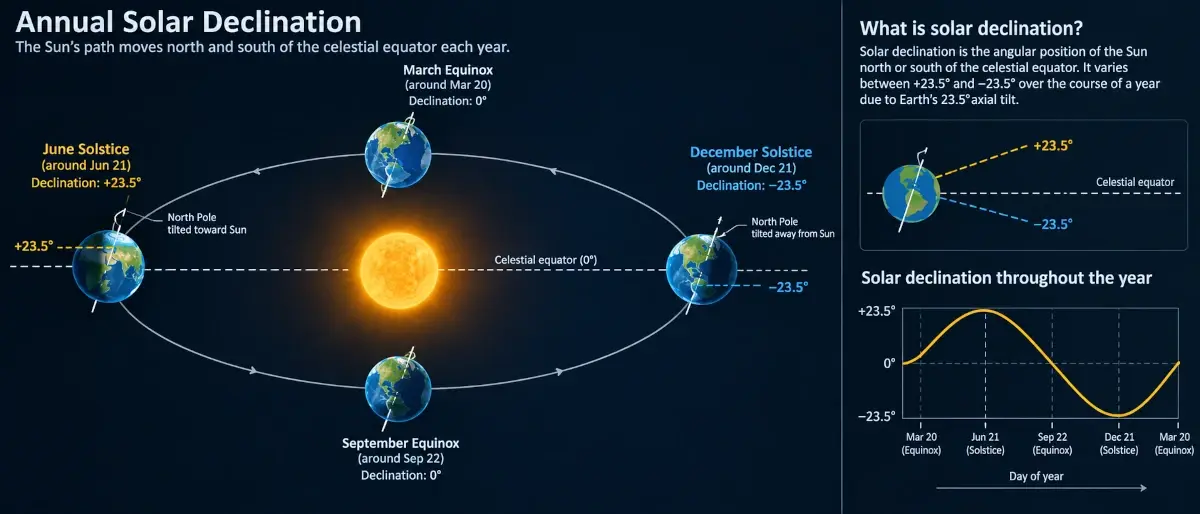
A solstice is the moment in Earth's orbit when the Sun reaches its maximum angular distance — its maximum declination — north or south of the celestial equator. Declination is the sky's equivalent of latitude: it measures how far a celestial object appears above or below the projection of Earth's equator onto the sky. Because Earth's axis is tilted relative to its orbital plane, the Sun's declination changes continuously through the year, swinging between roughly +23.4° and −23.4°. A solstice marks the turning point of that swing, the instant when the Sun's northward or southward drift momentarily halts before reversing direction.
The two annual solstices
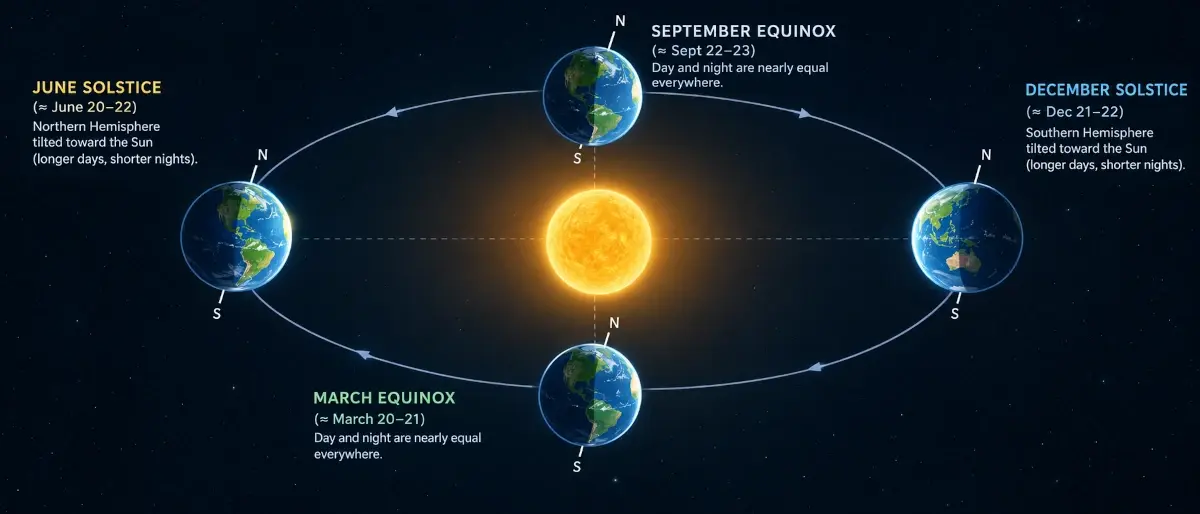
Earth experiences two solstices each year. The June solstice occurs when the Sun reaches its northernmost declination, directly overhead at the Tropic of Cancer near 23.4°N. The December solstice occurs when the Sun reaches its southernmost declination, directly overhead at the Tropic of Capricorn near 23.4°S. Because the hemispheres experience opposite illumination at any given time, the June solstice is the summer solstice in the Northern Hemisphere and the winter solstice in the Southern Hemisphere, while the December solstice reverses those roles.
Why the word "solstice" means "Sun standing still"
The term derives from the Latin sol (Sun) and sistere (to stand still). The name reflects an observational fact rather than a literal one: for several days surrounding a solstice, the point on the horizon where the Sun rises and sets changes so slowly that, to a naked-eye observer tracking it day to day, it appears to pause before reversing. This apparent stillness is explored in more detail later in this article.
The Earth's Axial Tilt
Earth's approximately 23.5° obliquity
Earth's rotational axis is not perpendicular to its orbital plane. Instead, it is tilted by approximately 23.5° — a value astronomers call obliquity. This tilt is the single most important geometric fact behind the existence of seasons and solstices. Without it, the Sun would remain permanently over the equator, day length would be constant everywhere, and solstices would not exist at all.
The orientation of Earth's rotational axis
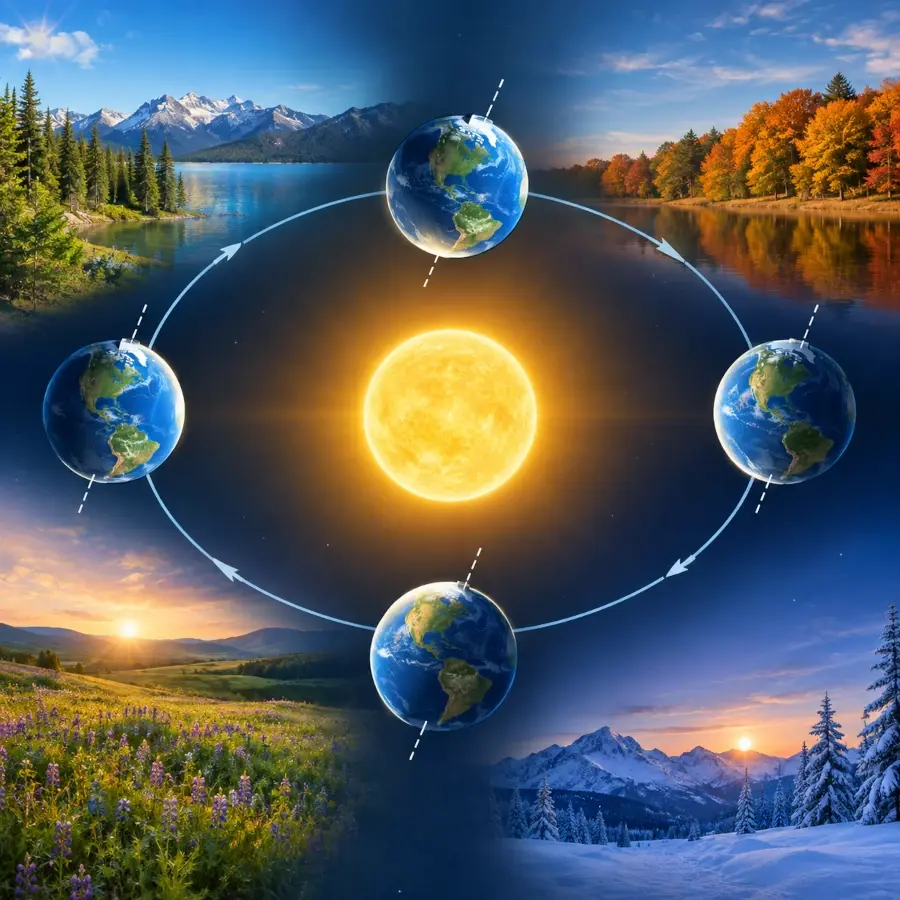
Over the course of a single year, Earth's axis maintains nearly the same orientation in space, pointing roughly toward the star Polaris in the Northern Hemisphere. The axis does not tilt toward or away from the Sun as Earth moves; it simply stays pointed in roughly the same direction. Because of this, different points in the orbit present different hemispheres more directly toward the Sun. In June, the Northern Hemisphere is tilted toward the Sun. In December, the Southern Hemisphere is tilted toward it instead. This fixed-axis, orbiting-planet arrangement produces the annual cycle of solar declination. Over much longer timescales, the axis's orientation does slowly change through a process called axial precession, discussed later in this article's section on long-term climate.
Why axial tilt is fundamental to the seasons
Axial tilt governs two things simultaneously: the angle at which sunlight strikes a given latitude, and the length of time that latitude spends in daylight versus darkness during a single rotation. Both effects intensify or weaken together, which is why the summer solstice combines the year's longest day with the year's most direct, highest-intensity sunlight at a given hemisphere's high latitudes, and the winter solstice combines the shortest day with the lowest sun angle.
Earth's Orbit Around the Sun
Earth's orbital path
Earth completes one orbit around the Sun approximately every 365.25 days, following a path that is very nearly circular but technically a slight ellipse, with an eccentricity of about 0.017. This orbital motion, combined with the fixed tilt of Earth's axis, is what causes the Sun's apparent position in the sky — its declination — to change gradually and predictably across the year.
The role of orbital position
As Earth moves along its orbit, the fixed orientation of its axis means that different points along the path correspond to different amounts of "lean" toward or away from the Sun, as seen from Earth. At the solstices, Earth occupies the two points in its orbit where its fixed axial tilt produces the greatest northward or southward solar declination. At the equinoxes, Earth occupies the two orbital positions where neither hemisphere is preferentially tilted toward the Sun.
Why seasons are not caused by Earth being closer to or farther from the Sun
A persistent misconception holds that seasons result from Earth's changing distance from the Sun. In reality, the opposite pattern holds: Earth is closest to the Sun (perihelion) in early January, during Northern Hemisphere winter, and farthest (aphelion) in early July, during Northern Hemisphere summer. The variation in distance across the orbit is only about 3.4%. That corresponds to roughly 6.8% more incoming solar radiation in January than in July — far too small, and pointed in the wrong direction, to explain the dramatic seasonal temperature swings seen at mid and high latitudes. Seasons are driven overwhelmingly by axial tilt, not orbital distance.
The Geometry of a Solstice
The celestial equator and ecliptic
Two reference circles on the celestial sphere are essential to understanding solstice geometry. The celestial equator is the projection of Earth's equator onto the sky. The ecliptic, meanwhile, is the apparent annual path of the Sun against the background stars, tracing the plane of Earth's orbit. Because Earth's axis is tilted by 23.4°, the ecliptic is inclined to the celestial equator by that same angle. As a result, the Sun's position relative to the celestial equator — its declination — oscillates as the Sun appears to move along the ecliptic through the year.
Solar declination
Solar declination is the angular distance of the Sun north or south of the celestial equator, analogous to latitude on Earth. It varies continuously through the year: zero at the equinoxes, rising to a maximum of about +23.4° at the June solstice, falling back through zero at the September equinox, and reaching a minimum of about −23.4° at the December solstice, before returning to zero at the March equinox to complete the cycle.
The Sun at approximately +23.4° and −23.4° declination
The solstices mark the two extremes of this cycle. At the June solstice, solar declination peaks near +23.4°, meaning the Sun's rays strike Earth's surface most directly at that latitude in the Northern Hemisphere. At the December solstice, declination bottoms out near −23.4°, and the most direct sunlight falls on the equivalent southern latitude.
The Tropic of Cancer and Tropic of Capricorn
These two latitude lines, at approximately 23.4°N and 23.4°S, mark the northernmost and southernmost points on Earth's surface where the Sun can ever appear directly overhead at local solar noon. The Sun sits at the zenith over the Tropic of Cancer at the June solstice and over the Tropic of Capricorn at the December solstice, a direct geographic consequence of the axial tilt described above. Between the two Tropics, the Sun passes directly overhead on two separate days each year at most latitudes. At the Tropics themselves, by contrast, this overhead passage happens only once per year, at the solstice. Outside the Tropics, the Sun never reaches the zenith at all.
The significance of the solstitial points
The two points in Earth's orbit corresponding to the solstices are often called the solstitial points. They represent the orbital positions at which the tilt of Earth's axis is maximally aligned with — rather than perpendicular to — the Earth–Sun line, producing the year's most extreme distribution of daylight and solar intensity between the hemispheres.
Solar altitude at local noon
The Sun's altitude at local solar noon follows directly from latitude and solar declination. It can be approximated as: solar noon altitude ≈ 90° − |latitude − solar declination|. At 40°N, for example, this gives a noon Sun altitude of about 73.4° at the June solstice (90° − |40° − 23.4°|) and about 26.6° at the December solstice (90° − |40° − (−23.4°)|) — a swing of nearly 47° across the year at that single latitude. In other words, this relationship is what makes the qualitative statements above, that the Sun is "higher" in summer and "lower" in winter, precise and quantifiable.
The relationship between latitude, declination, and day length
Day length at a given latitude is likewise a direct mathematical function of latitude and solar declination, not just a qualitative outcome of the tilt. As the magnitude of solar declination increases toward its solstice extreme, daylight duration increases in the hemisphere tilted toward the Sun and decreases in the hemisphere tilted away. The size of this effect grows with distance from the equator. This is the same latitude–declination relationship explored in more detail in the sections on daylight and on latitude below — the solstice is simply the point in the year where the underlying declination term reaches its maximum magnitude.
The Summer Solstice
What happens astronomically
The summer solstice occurs when a given hemisphere is tilted most directly toward the Sun, placing solar declination at its most extreme value for that hemisphere — approximately +23.4° for the Northern Hemisphere in June, and approximately −23.4° for the Southern Hemisphere in December.
Maximum solar declination
For the hemisphere experiencing summer, this is the date on which the Sun reaches the highest declination of the year relative to that hemisphere, translating into the highest possible solar altitude at local noon for most mid and high latitudes in that hemisphere.
Longest daylight period
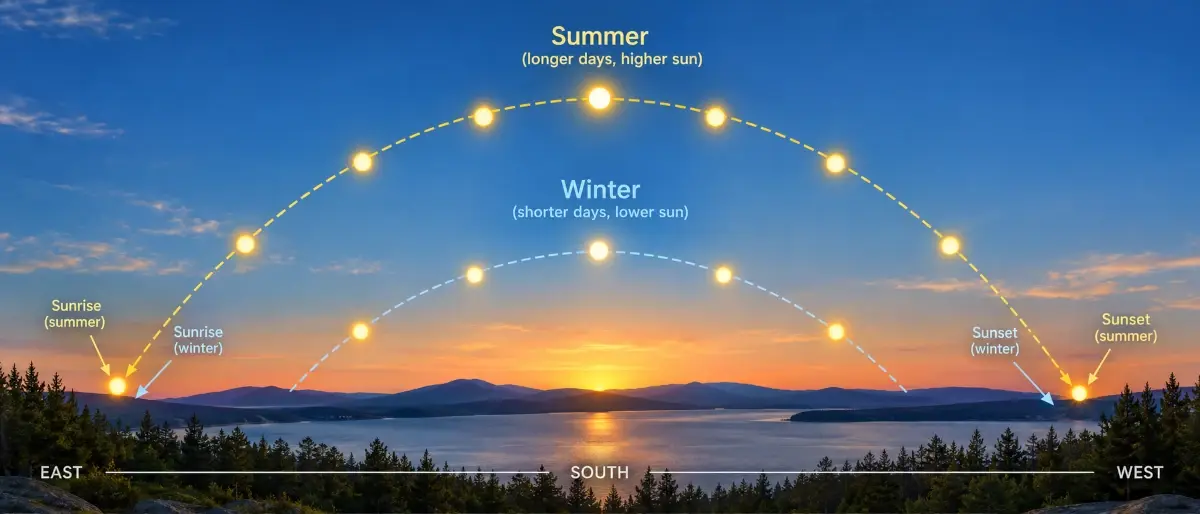
Because the summer hemisphere is tilted toward the Sun, a larger portion of each latitude circle in that hemisphere remains in sunlight during a full rotation of the Earth. The result is the longest daylight period of the year at every latitude in that hemisphere, with the effect growing more extreme closer to the pole.
Solar altitude and intensity
At the summer solstice, the Sun climbs higher in the sky at local noon than on any other day of the year for most mid- and high-latitude locations in that hemisphere. (Locations within the Tropics are an exception: they can see a higher noon Sun on one of their two annual zenith-passage days.) A higher solar altitude means sunlight strikes the surface at a steeper angle. This concentrates the Sun's energy over a smaller surface area and sends it through less atmosphere, and both factors increase the intensity of solar radiation reaching the ground.
Northern and Southern Hemisphere differences
The June solstice is the summer solstice in the Northern Hemisphere and the winter solstice in the Southern Hemisphere; the December solstice reverses these roles. The two hemispheres are always in opposite seasons at any given solstice, a direct consequence of their opposite tilt relative to the Sun at that point in the orbit.
The Winter Solstice
What happens astronomically
The winter solstice occurs when a given hemisphere is tilted most directly away from the Sun, placing solar declination at its most extreme value in the opposite direction from that hemisphere.
Minimum solar declination
For the hemisphere experiencing winter, this is the date on which the Sun's declination is farthest from that hemisphere, producing the lowest solar altitude of the year at local noon for most latitudes in that hemisphere.
Shortest daylight period
With the winter hemisphere tilted away from the Sun, a smaller portion of each latitude circle in that hemisphere is illuminated during a full Earth rotation, producing the shortest daylight period of the year — again, an effect that intensifies toward the pole.
Solar altitude and intensity
At the winter solstice, the Sun reaches its lowest noon altitude of the year for that hemisphere. Low solar altitude spreads incoming radiation over a larger surface area and forces it through a greater thickness of atmosphere, both of which reduce the intensity of solar energy reaching the ground.
Northern and Southern Hemisphere differences
Just as with the summer solstice, the winter solstice at one hemisphere corresponds to the summer solstice at the other. The December solstice is winter in the north and summer in the south; the June solstice reverses this.
Why Daylight Changes at the Solstice
Earth's rotation
Day and night arise from Earth's rotation on its axis, completed roughly every 24 hours. At any moment, half of Earth's surface faces the Sun and experiences daylight while the other half faces away and experiences night. The boundary between these two regions is called the circle of illumination.
The changing path of the Sun across the sky
Because the axis is tilted, the circle of illumination does not align with lines of latitude except at the equinoxes. At other times of year, it cuts across each latitude circle at an angle, so points on that latitude spend unequal amounts of time on the daylight and nighttime sides of the circle as Earth rotates. This produces the changing length of day characteristic of most latitudes throughout the year.
Latitude and day length
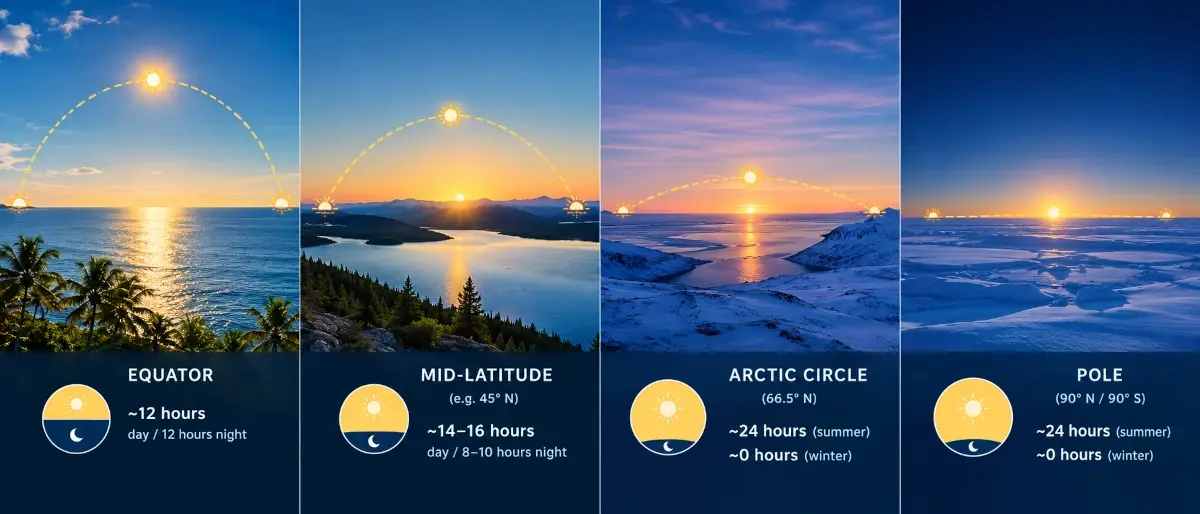
The amount by which day length departs from 12 hours grows with distance from the equator. Near the equator, day length stays close to 12 hours all year, since the circle of illumination nearly bisects every latitude circle there regardless of season. At progressively higher latitudes, the seasonal swing in day length becomes larger.
Why the effect is extreme near the poles
Near the poles, the circle of illumination can fail to cross a given latitude circle at all for extended periods, producing continuous daylight (polar day) around the summer solstice or continuous darkness (polar night) around the winter solstice. This is the most extreme expression of the same geometric principle that produces modest day-length changes at mid-latitudes.
Does the Sun Actually "Stand Still"?
The apparent meaning of solstice
The Sun does not physically stop moving at a solstice — Earth's orbital motion is continuous. The "standing still" refers to the Sun's apparent north–south drift in the sky, not its daily east–west motion, which continues without interruption.
Changes in solar declination
Solar declination changes fastest near the equinoxes and slowest near the solstices. This is a direct result of the sinusoidal shape of the annual declination curve: because the Sun's apparent motion along the ecliptic projects onto declination at an angle set by the 23.4° tilt, that projection traces out a curve close to a sine wave over the year. Near the peak and trough of a sine wave, the rate of change approaches zero, so the Sun's north–south position changes only slightly from one day to the next in the days surrounding a solstice — while near the zero-crossings, which correspond to the equinoxes, the rate of change is at its greatest.
Why sunrise and sunset positions appear to pause
Because sunrise and sunset azimuth (the compass direction of rising and setting, measured from due north) is tied closely to solar declination, the same flattening near the solstice causes the sunrise and sunset points on the horizon to shift only minimally from day to day for roughly a week or two around the solstice date — the observational basis for the term "solstice."
The Sun's changing path across the horizon
Across the year, the compass points where the Sun rises and sets swing back and forth along the horizon in step with declination. At a Northern Hemisphere mid-latitude, the Sun rises north of due east and sets north of due west around the June solstice; it rises and sets very close to due east and due west at the equinoxes; and it rises south of due east and sets south of due west around the December solstice (with the directions mirrored in the Southern Hemisphere). The amount of this side-to-side swing grows with latitude, which is part of why the same solstice-aligned horizon markers used by ancient observers, discussed later in this article, work reliably only for a fixed observing location.
The gradual reversal of seasonal change
After the solstice, declination begins moving in the opposite direction, at first very slowly and then with increasing speed as the year approaches the following equinox. This gradual reversal is why the days immediately following a solstice show almost no perceptible change in length, while the days around an equinox show the most rapid change in day length of the entire year.
Solstices at Different Latitudes
Equator
At the equator, the geometrical interval during which the Sun's center is above the horizon remains close to 12 hours throughout the year, including at the solstices, because the circle of illumination divides the equator into two equal arcs regardless of the Sun's declination. Actual observed daylight is slightly longer than this due to atmospheric refraction and the finite size of the Sun's disk, the same two effects discussed later in this article's misconceptions section. What changes at the equator across the year is not day length but the Sun's noon altitude and the timing of its two annual zenith passages.
Mid-latitudes
At mid-latitudes — the range where most populated regions of Earth lie — the solstices mark the annual extremes of day length, typically producing a difference of several hours between the shortest and longest day, along with the year's highest and lowest noon Sun altitudes.
Arctic and Antarctic Circles
At the Arctic Circle (about 66.5°N) and Antarctic Circle (about 66.5°S), the solstices mark the threshold of continuous daylight or continuous darkness. In the ideal geometric model, the Sun remains on or above the geometric horizon for a full 24-hour rotation at the summer solstice at that exact latitude, and on or below it for the same period at the winter solstice. Actual observed sunrise and sunset times differ slightly from this idealized threshold because of atmospheric refraction and the Sun's finite disk size, both of which tend to extend visible daylight a little beyond the purely geometric prediction.
Polar day and polar night
Poleward of the Arctic and Antarctic Circles, the periods of continuous daylight (polar day, or the "midnight sun") and continuous darkness (polar night) extend for progressively longer stretches of the year as latitude increases, reaching roughly six months of each at the poles themselves.
Why there is no conventional "longest day" at the equator
Because the equator's day length barely varies across the year, the concept of a "longest day" carries little meaning there. The solstices are still astronomically real at the equator — the Sun's declination still reaches its annual extremes — but their local effect on daylight duration is negligible compared to their effect at higher latitudes.
Solstice vs. Equinox
What defines an equinox
An equinox occurs when the Sun's declination crosses zero — the moment the Sun appears directly over the celestial equator. This happens twice a year, in March and September, at the two orbital positions between the solstices where the Sun's declination makes this crossing. Because Earth's orbit is elliptical rather than perfectly circular, these two points are not necessarily equally spaced in time or physical distance from the solstices.
Solar declination at the equinoxes
At an equinox, Earth's axial tilt is oriented so that neither hemisphere is preferentially tilted toward the Sun; both hemispheres receive a comparable, though not perfectly identical, distribution of daylight and darkness.
Day and night near equal length
Day and night are close to equal at the equinoxes almost everywhere on Earth, though not exactly equal, for reasons addressed later in this article's discussion of common misconceptions. The near-equality applies globally, in contrast to the solstices, whose daylight extremes are opposite in the two hemispheres.
Comparing the four astronomical turning points of the year
| Event | Approximate Date | Solar Declination | Northern Hemisphere Effect |
|---|---|---|---|
| March equinox | Around March 20 | 0° | Day and night near equal; spring begins |
| June solstice | Around June 21 | +23.4° | Longest day; summer begins |
| September equinox | Around September 22 | 0° | Day and night near equal; autumn begins |
| December solstice | Around December 21 | −23.4° | Shortest day; winter begins |
Why the Solstice Does Not Produce the Hottest or Coldest Day
Seasonal thermal lag
Although the summer solstice marks the year's maximum solar declination and, outside the Tropics, typically the longest daylight and highest noon Sun altitude, it does not necessarily correspond to the maximum total solar energy received by a hemisphere — Earth is near aphelion around the June solstice and near perihelion around the December solstice, an orbital-distance effect discussed earlier in this article. Nor does the solstice typically coincide with the hottest day of the year: the warmest average temperatures usually arrive weeks later. This delay, known as seasonal thermal lag, occurs because the Sun continues delivering more energy than the Earth radiates away for some time after the solstice, allowing accumulated heat to keep building even as daily insolation begins to decline.
Land and ocean heat capacity
Land surfaces heat and cool relatively quickly, so thermal lag is shorter near continental interiors. Oceans, by contrast, have a much higher heat capacity and absorb and release heat far more slowly, producing a longer lag between peak sunlight and peak temperature — one reason coastal regions often see their warmest weeks well into the summer season.
Atmospheric effects
The atmosphere and surface act together as a thermal reservoir, continuing to absorb, store, and re-radiate energy after the solstice. Cloud cover, humidity, and regional circulation patterns further modulate how quickly this stored heat translates into peak surface temperatures.
Why maximum temperatures usually occur after the summer solstice
The combination of thermal lag effects means that, in many Northern Hemisphere locations, the warmest part of the year occurs some weeks after the June solstice, with a mirrored pattern of the coldest weeks trailing the December solstice — although the exact timing varies considerably with latitude, continentality, ocean influence, and local climate.
The Solstice and Earth's Seasons
Astronomical seasons
Astronomical seasons are defined by Earth's orbital position relative to the Sun, with each season beginning at a solstice or equinox: spring at the March equinox, summer at the June solstice, autumn at the September equinox, and winter at the December solstice (dates reversed for the Southern Hemisphere).
Meteorological seasons
Meteorologists and climatologists commonly use a different system, meteorological seasons, which divide the year into four three-month blocks aligned with the calendar month rather than the exact astronomical event — for example, meteorological summer in the Northern Hemisphere runs from June 1 through August 31.
The relationship between solar energy and seasonal temperature
Both systems attempt to describe the same underlying physical reality: the annual cycle of incoming solar energy driven by axial tilt. The astronomical system tracks the geometric cause directly, while the meteorological system is built around the resulting temperature patterns, which lag behind the geometric cycle for the thermal-lag reasons discussed above.
Why the two systems use different dates
Because meteorological seasons are designed around observed temperature trends and consistent calendar boundaries useful for record-keeping and forecasting, they intentionally do not track the exact, year-to-year shifting dates of the solstices and equinoxes, which the astronomical system does track precisely.
How Solstice Dates and Times Are Determined
The precise astronomical definition
Astronomers define a solstice as the exact moment the Sun's ecliptic longitude reaches 90° (June solstice) or 270° (December solstice). This corresponds to the instant of maximum or minimum solar declination. It is a precise moment in time, not a full calendar day, and astronomers calculate it down to the minute using Earth's orbital and rotational parameters.
Earth's orbital and rotational geometry
Earth's orbital speed varies slightly because its path is elliptical. On top of that, the tropical year is not an exact whole number of days. Together, these two facts mean the precise moment of each solstice shifts from year to year rather than falling at a fixed clock time on a fixed date.
Why the exact time changes from year to year
The tropical year, the time between successive June solstices, runs close to 365.2422 days rather than a round 365. This roughly quarter-day surplus pushes the solstice moment about six hours later each year. Leap years periodically reset that drift, which produces the familiar pattern of solstice dates shifting between approximately June 20 and June 22 (and similarly for December).
UTC versus local time
The solstice is a single instant in time, so it corresponds to a specific moment in Coordinated Universal Time (UTC). That moment then translates to different local clock times and, in some cases, different calendar dates depending on a location's time zone.
Why the calendar date can differ by location
A solstice occurring late in the day UTC may fall on the following calendar date for locations west of the UTC line, and on the preceding date for locations far enough east. That is why some years show the solstice listed as December 21 in one region and December 22 in another.
Solar noon is not necessarily 12:00
This article repeatedly refers to solar altitude "at local noon," meaning local solar noon: the moment the Sun reaches its highest point in the sky for a given location on a given day, not 12:00 on the clock. Solar noon rarely lines up exactly with clock noon. Several factors compound to create the gap: a location's position within its time zone, since time zones span a range of longitudes but keep a single clock time; Earth's varying orbital speed and axial tilt, which combine into what astronomers call the equation of time; and, where applicable, daylight-saving time offsets. Together, these can shift solar noon from clock noon by up to roughly 15 to 20 minutes in either direction across the year, even before accounting for a location's distance from its time zone's reference meridian.
Solstices and Earth's Long-Term Climate
Axial obliquity
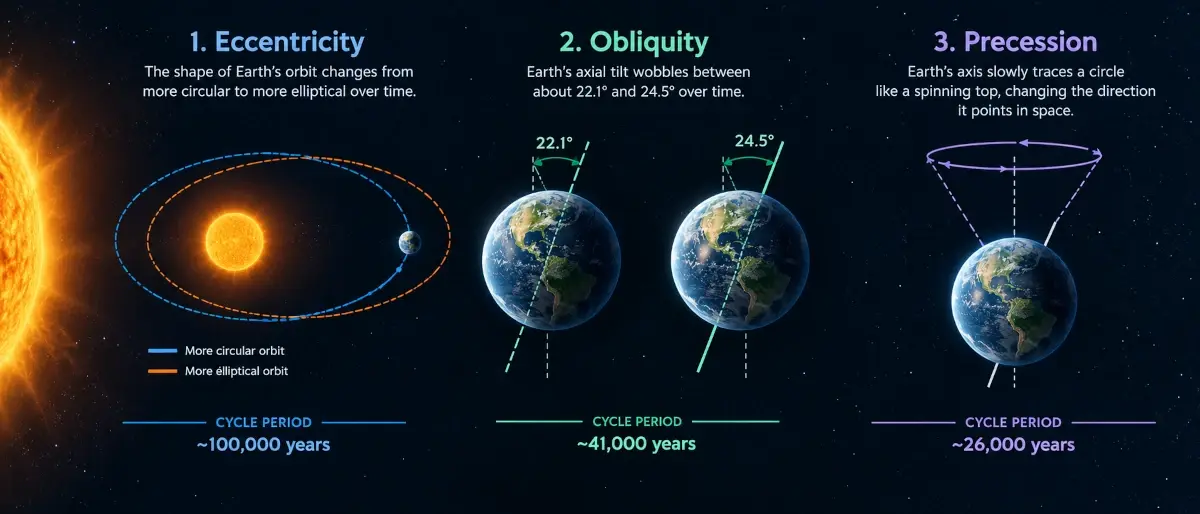
Earth's axial tilt is not perfectly fixed over long timescales. It oscillates between about 22.1° and 24.5° over a cycle lasting roughly 41,000 years. A larger tilt intensifies the contrast between summer and winter solar input at high latitudes; a smaller tilt moderates it.
Precession
Earth's axis also slowly traces a cone-shaped path in space, called axial precession, completing one cycle roughly every 26,000 years. Precession changes which point in Earth's orbit corresponds to a given solstice relative to the seasons, gradually shifting the alignment between the solstices and Earth's closest and farthest points from the Sun.
Orbital eccentricity
The shape of Earth's orbit itself varies over time, cycling between more circular and more elliptical configurations on a period of roughly 100,000 years. Greater eccentricity amplifies the difference in solar energy Earth receives at perihelion versus aphelion, interacting with precession to influence how extreme the seasonal cycle becomes in a given hemisphere.
Milankovitch cycles
These three long-period variations — obliquity, precession, and eccentricity — are collectively known as Milankovitch cycles, after the geophysicist who developed their modern mathematical treatment. Although each cycle operates on a timescale far longer than a human lifetime, together they periodically strengthen or weaken the seasonal contrast at high latitudes.
How orbital variations influence long-term climate
Milankovitch cycles are an important driver of long-term changes in Earth's climate, including the timing of glacial–interglacial cycles over the past several million years, by altering the seasonal and latitudinal distribution of incoming solar radiation — particularly how much summer solar energy reaches the high-latitude regions where ice sheets form and persist.
Solstice Observations and Human History
Ancient astronomical observations
Long before the underlying orbital mechanics were understood, ancient observers across many cultures tracked the changing position of sunrise and sunset on the horizon and recognized the solstices as fixed, predictable turning points in that cycle.
Calendars and agriculture
Because the solstices recur at consistent intervals, solstices and other seasonal astronomical observations provided useful reference points for calendars and for tracking the progression of the agricultural year in many societies.
Solstice monuments and alignments
A number of ancient structures, most famously Stonehenge in England, feature alignments that correspond closely to sunrise or sunset directions at the solstices, suggesting that their builders incorporated solar observation into the structures' design or ceremonial use.
Cultural significance
Solstices have been marked by festivals and rituals in numerous cultures throughout history, often tied to themes of light's return (at the winter solstice) or the peak of the growing season (at the summer solstice).
Distinguishing archaeological evidence from modern interpretations
Interpreting the precise intent behind ancient solstice-aligned structures requires care: while alignment with solstice sunrise or sunset points can often be measured and confirmed, the specific cultural or religious meaning attached to that alignment by the original builders is frequently inferred rather than directly documented, and modern interpretations should be distinguished from confirmed historical record.
Common Misconceptions About Solstices
"The Earth is closest to the Sun in summer"
As noted earlier, the opposite is true for the Northern Hemisphere: Earth is nearest the Sun (perihelion) in early January, during Northern Hemisphere winter, and farthest (aphelion) in early July, during Northern Hemisphere summer. The resulting difference in solar radiation received (about 6.8% more in January than July) runs opposite to the seasonal pattern it would need to explain. Seasons are governed by axial tilt, not distance from the Sun.
"The solstice is the hottest/coldest day"
Due to seasonal thermal lag, the hottest and coldest days of the year typically occur several weeks after the respective solstice, once accumulated heating or cooling has caught up with the changing solar input.
"Day and night are exactly equal at the equinox"
Day and night are close to, but not precisely, equal at the equinox. Two factors account for the discrepancy: atmospheric refraction bends sunlight so the Sun remains visible slightly after it has geometrically dropped below the horizon, and daylight is conventionally measured from the first appearance of the upper limb of the Sun's disk at sunrise to its last appearance at sunset, rather than from the Sun's geometric center — both effects add a few extra minutes of daylight beyond a true 12-hour split.
"The Sun literally stops moving"
The Sun's apparent daily east-to-west motion across the sky, caused by Earth's rotation, never pauses. Only the Sun's slow north–south drift in declination temporarily flattens out near the solstice, which is the origin of the term.
"The solstice happens because Earth changes its tilt during the year"
Earth's axial tilt itself remains essentially constant — around 23.4° — throughout the year. What changes is Earth's position in its orbit relative to that fixed tilt, which alters how directly each hemisphere faces the Sun. The tilt does not change on a yearly basis; it only varies very slowly over tens of thousands of years, as described in the Milankovitch cycles section above.
Frequently Asked Questions
What exactly happens during a solstice?
The Sun reaches its maximum declination north or south of the celestial equator. At that moment, one hemisphere is tilted most directly toward the Sun, and the other is tilted most directly away.
Why are there two solstices?
Earth's orbit carries it through two points each year. At each point, the planet's fixed axial tilt produces the maximum lean toward the Sun for one hemisphere and the maximum lean away for the other. Those two points are the June and December solstices.
Which day is the longest day of the year?
The summer solstice is the longest day of the year for a given hemisphere. In the Northern Hemisphere, that falls around June 21; in the Southern Hemisphere, around December 21.
Is the solstice the same everywhere on Earth?
The solstice itself is a single global moment in time. However, its effect on day length varies enormously by latitude: negligible at the equator, moderate at mid-latitudes, and extreme near the poles, where it can mean continuous daylight or continuous darkness.
Why does the date of the solstice change?
The tropical year runs close to 365.2422 days, not an exact 365. As a result, the solstice moment drifts about six hours later each year. Leap years periodically reset that drift, which produces the small year-to-year variation in solstice dates.
What is the difference between a solstice and an equinox?
A solstice marks the Sun's maximum declination, its greatest angular distance from the celestial equator. An equinox, by contrast, marks the moment the Sun's declination crosses zero, directly over the celestial equator.
Why are the seasons opposite in the two hemispheres?
Earth's axis keeps a fixed orientation in space as the planet orbits the Sun. Because of this, one hemisphere is always tilted toward the Sun while the other is tilted away, so the two hemispheres experience opposite seasons at any given point in the orbit.
Conclusion
A solstice is the observable endpoint of a chain of physical causes. Earth's roughly 23.4° axial tilt, combined with its steady orbital motion around the Sun, produces a continuously changing solar declination throughout the year. That changing declination governs both the Sun's altitude in the sky and the length of daylight at every latitude, reaching its two annual extremes at the solstices. In short, everything commonly associated with a solstice — the longest or shortest day, the highest or lowest sun angle, the near-stationary sunrise and sunset points — follows directly from this underlying geometry. None of it comes from a change in Earth's distance from the Sun, and none of it comes from any shift in axial tilt during the year.